How Pendulum’s Design of UWM Field Embodies Sustainable Ballpark Development

When Jimmy John’s Field (now UVM Field) opened in Utica, Michigan in 2016, it represented far more than a new ballpark. It was the realization of a bold vision centered on community revitalization, affordable family entertainment, and the power of sports to transform overlooked spaces into civic destinations.

Recently, the venue entered a new chapter under its new identity, UWM Field, following a long-term naming rights partnership between the USPBL and United Wholesale Mortgage. Yet while the name on the marquee has changed, the impact of the project remains deeply rooted in the original vision that shaped the ballpark from day one.

Pendulum was proud to play a role in the development and design strategy behind one of the most unique baseball experiences in independent professional sports. Located in downtown Utica along the M-59 corridor, the ballpark was intentionally designed as more than a sports venue. It became an entertainment anchor for the region and a catalyst for economic activity within the community. The site itself carried symbolic importance, transforming a long-vacant brownfield and former landfill into an active civic gathering place that now welcomes millions of visitors.

The Home Team Always Wins!

From the beginning, UWM Field embodied many of the principles that continue to define Pendulum’s work today: experiential design, operational flexibility, fan-centered programming, and community integration. The venue combined professional baseball with social gathering spaces, premium hospitality experiences, entertainment zones, family amenities, and multi-purpose event capabilities that helped redefine expectations for independent league facilities.

Perhaps most importantly, the facility became a living example of economic sustainability through intelligent operational design (S.C.O.R.E.). UVM Field was developed around a unique model in which four teams within a single professional league operate out of one shared facility. That approach maximized operational efficiency, concentrated attendance and revenue opportunities, reduced overhead, and created a consistent calendar of activity that continuously activated the venue and surrounding district. Years later, the success of that model continues validating Pendulum’s belief that thoughtful venue design can directly support long-term financial sustainability for teams, operators, and communities alike.

The Rise of a Market Challenger

The success of the USPBL validated that approach almost immediately. The league established itself as a developmental platform for players while simultaneously creating one of Metro Detroit’s most accessible and affordable sports entertainment destinations. Since opening, the ballpark has welcomed more than two million fans and has helped dozens of players advance toward Major League Baseball opportunities.

What makes projects like UWM Field especially meaningful is their ability to evolve with the community around them. The recent rebrand reflects not only a change in sponsorship, but the continued maturation of the venue as a long-term civic asset tied closely to the identity and growth of Metro Detroit.

For Pendulum, looking back on this project is a reminder that successful venues are never simply about architecture or construction. They are about creating places where people gather, communities connect, and memories are built season after season.

A decade later, the ballpark continues fulfilling that vision. Congratulations to the USPBL on an exceptional run to date, with many more successful seasons ahead.
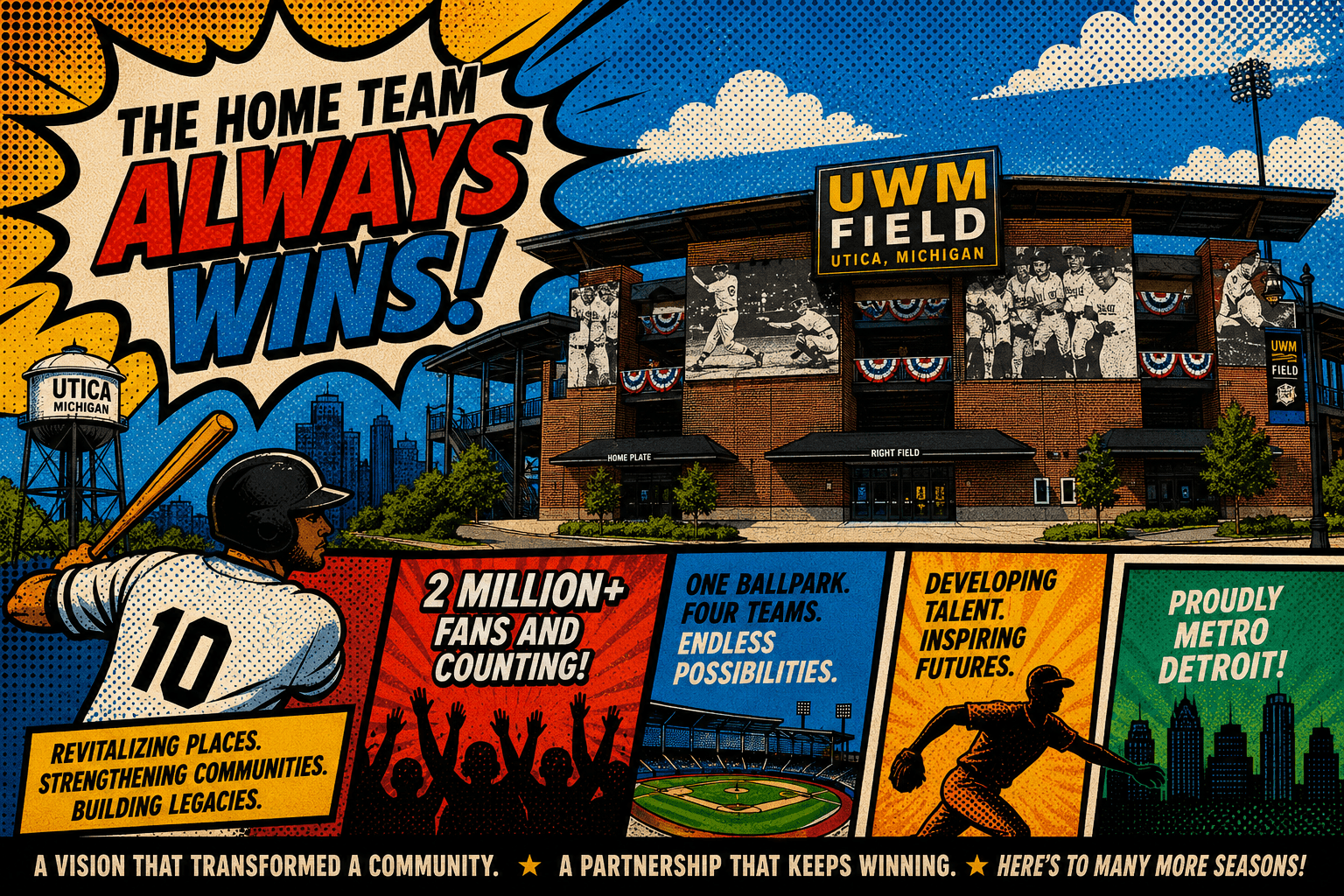
Pop art poster of UWM Field in Utica, Michigan, celebrating USPBL baseball, fans, and community revitalization.

Ballpark Design: The Discipline Behind Doing More with Less

In June 2021, Joe Mock of BaseballParks.com and USA Today Sports wrote, “Architect Cole has broken the code for creating 5,000-seat ballparks for half the budget of other such facilities.” As the 2026 class of MiLB facilities continues to emerge, Mock’s observation has only become more validated.

During a recent visit to WiSE Park (click the link to see the in-depth review), as we watched an evening game unfold, Joe posed a direct question: “how is it possible to deliver ballparks of comparable scope at a fraction of the cost? Many in the industry speak with pride about nine-figure budgets. Yet your projects consistently come in significantly below that threshold without feeling diminished. What is being removed, and where is the tradeoff?”

The answer begins with a reframing of the premise

Aerial evening rendering of Dunkin’ Donuts Park in Hartford, Connecticut, showcasing the stadium’s integration within the downtown urban core alongside Interstate 84 and surrounding mixed-use development. The image highlights the ballpark’s role in city revitalization, entertainment district planning, and modern sports venue design within a dense metropolitan environment.
Dunkin’ Park Downtown Aerial Image

Consider Dunkin’ Park in Hartford, completed in 2017 at approximately $67 million. WiSE Park, delivered nearly a decade later, came in at roughly $64 million, plus an additional $15 million for an adjacent hotel. These projects exist in very different contexts. Dunkin’ Park is embedded within a complex urban brownfield, shaped by challenging topography and dense infrastructure. WiSE Park sits on a former industrial site in a less dense suburban environment. Conventional thinking would suggest that the latter, built years later, would carry a significantly higher cost. Instead, the opposite occurred.

The distinction lies in right-sizing. There is no universal template for a successful ballpark. Each market demands a tailored response. What works in Hartford does not necessarily translate to Wilson. Dunkin’ Park includes twenty suites. WiSE Park has eight. That is not a compromise; it is alignment with demand.

The more consequential factor, however, is how the design anticipates change

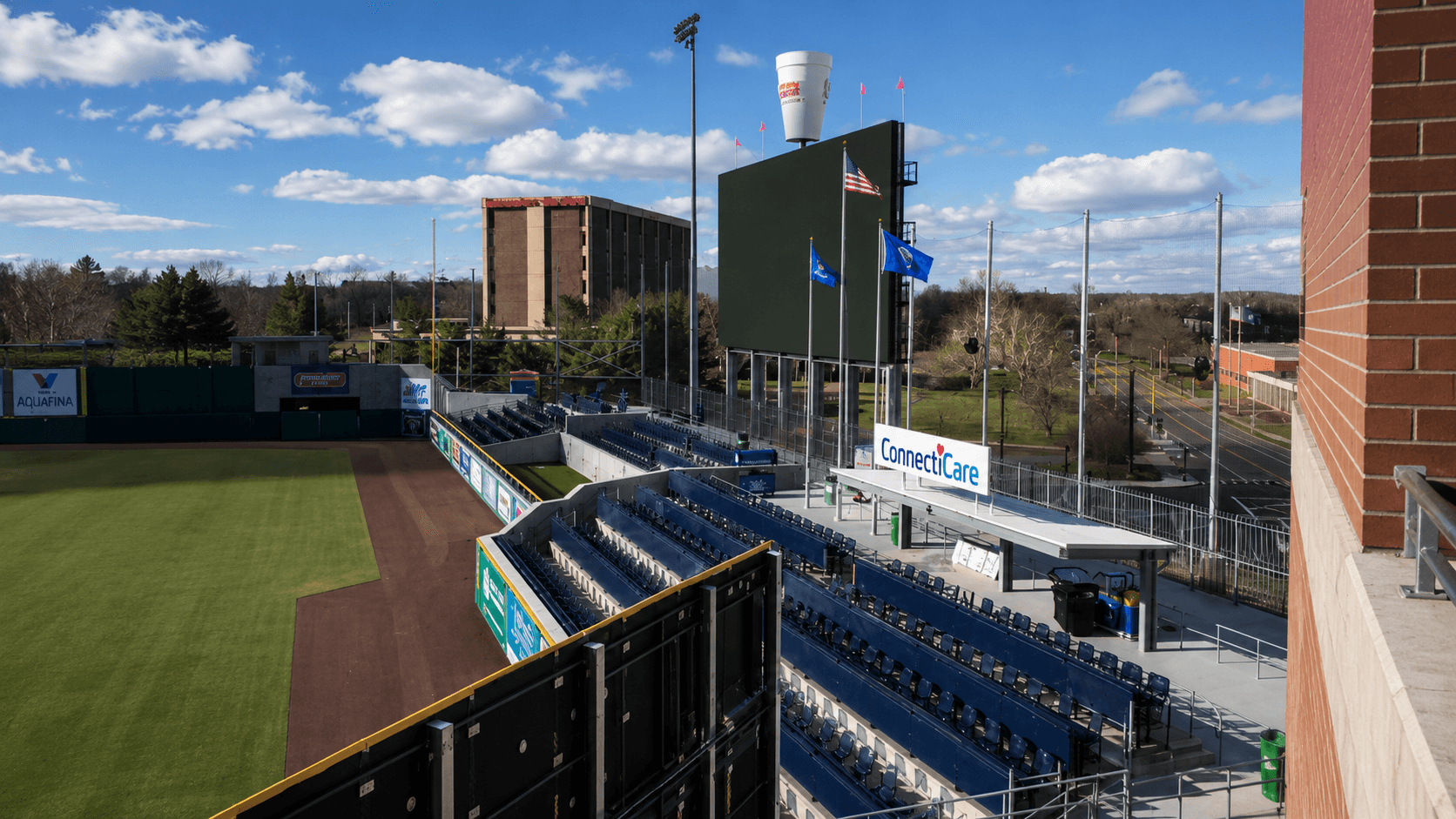
Wide-angle view of Dunkin’ Park in Hartford, Connecticut, showcasing the outfield seating bowl, premium spectator areas, scoreboard, and concourse circulation within the urban baseball stadium environment. The image highlights the ballpark’s integration of fan amenities, modern sports venue design, and experiential planning elements that support year-round entertainment and community activation.
Dunkin’ Park Original Outfield Concourse

Every project is conceived with room for organic growth. At Dunkin’ Park, ownership and leadership embraced an iterative approach from the outset. Rather than viewing the ballpark as a finished product on opening day, it was treated as a platform that would evolve alongside its fans. Over time, Pendulum has continued to engage in periodic design charrettes with the team to evaluate performance, identify opportunities, and respond to real behavioral data.

Children and families gather in the interactive Fun Zone at Dunkin’ Park in Hartford, Connecticut, featuring a large inflatable slide, playful fan amenities, and colorful entertainment areas designed to enhance the family-friendly baseball experience.
Dunkin’ Park Original Travelers Playground Area
Fans gather along the outfield concourse at Dunkin’ Park in Hartford, Connecticut, surrounding Bear’s Smokehouse BBQ, a signature food and social destination integrated directly into the ballpark experience with premium views, local dining, and active fan engagement.
Dunkin’ Park Original Bear’s BBQ Deck

From the beginning, the ballpark was organized into distinct experiential zones. A local restaurant, Bear’s BBQ, was integrated along the third base line, complete with an on-site smoker that introduced aroma as part of the atmosphere. A family-focused area behind the batter’s eye included a playground and live animal elements tied to the team’s identity. A social bar in right-center field was designed with minimal fixed seating to attract a younger, more mobile crowd.

Not all of these elements remained static, nor were they intended to

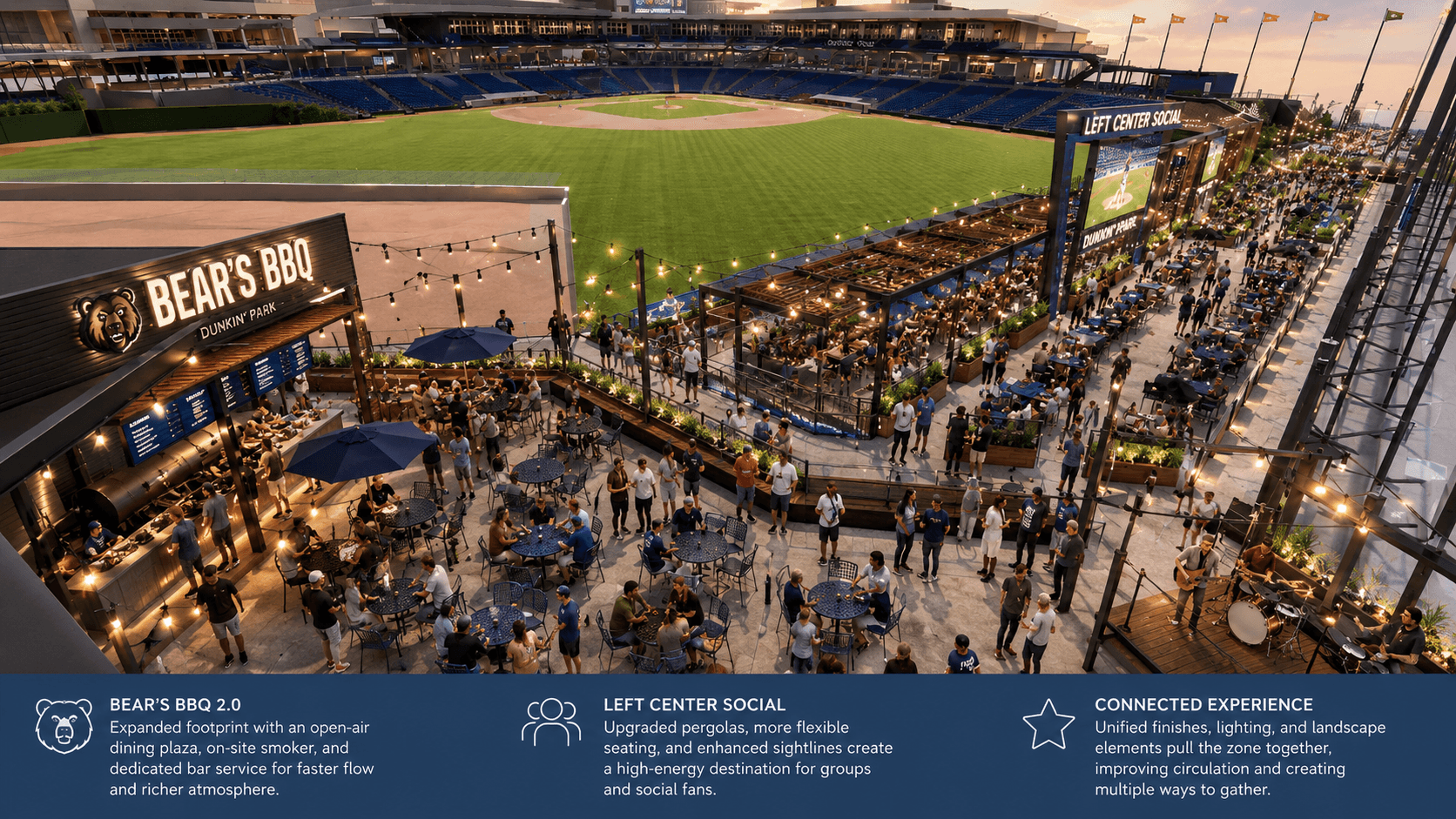
Pendulum’s Outfield Concourse Upgrade Concept
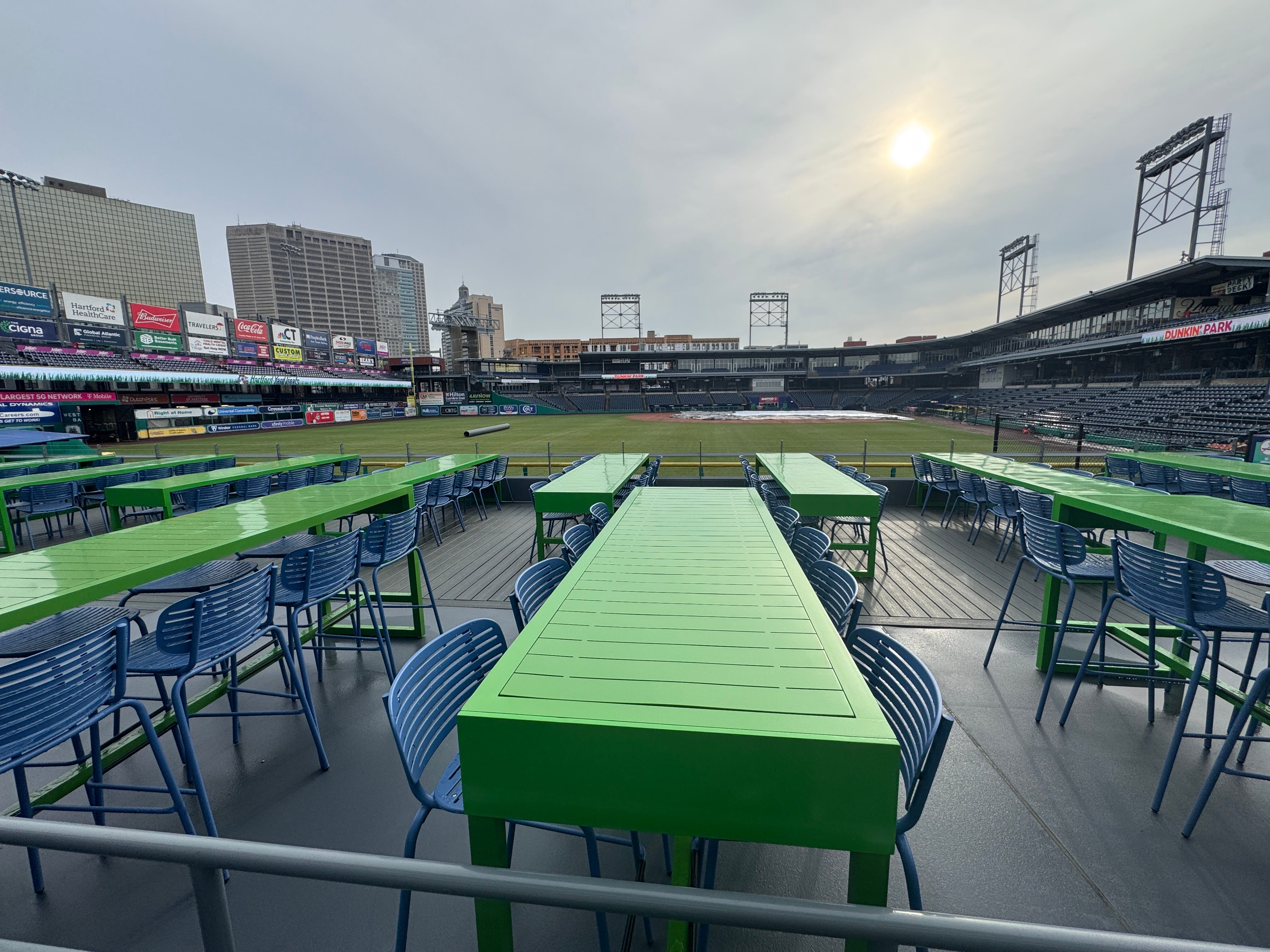
Field-level social seating at Dunkin’ Park in Hartford, Connecticut offers fans an immersive baseball experience with communal tables, premium sightlines, and flexible gathering spaces positioned directly along the outfield edge. Designed to encourage social interaction and enhance fan engagement, the hospitality-focused seating area reflects the evolution of modern ballpark architecture toward more dynamic, experience-driven environments.
Dunkin’ Park New Outfield Deck Seating
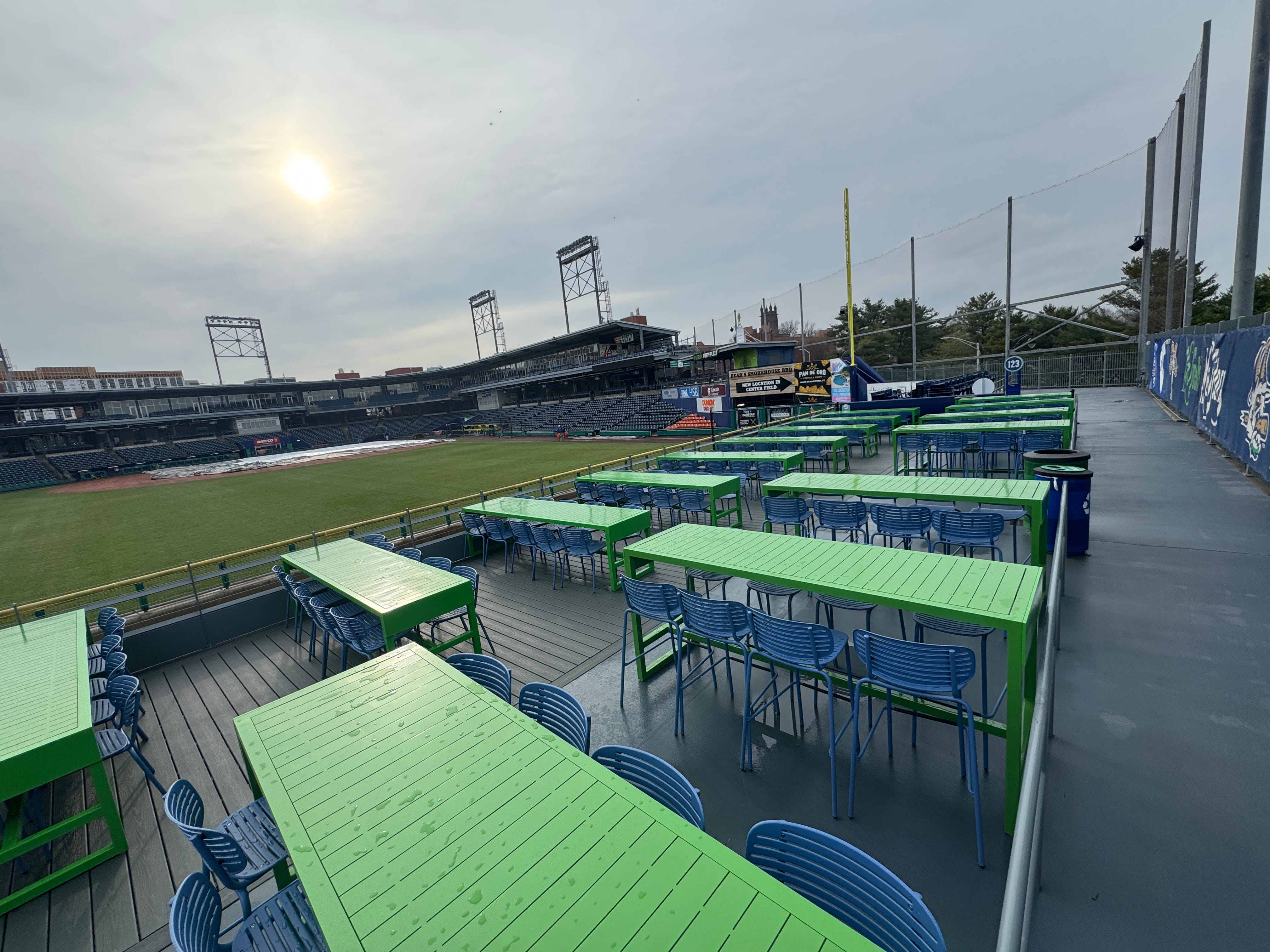
Wide view of the field-level social terrace at Dunkin’ Park in Hartford, Connecticut, featuring communal high-top tables and flexible group seating positioned directly along the outfield edge. The hospitality-focused seating area creates an immersive fan experience with panoramic ballpark views, encouraging social interaction, premium event hosting, and modern experience-driven baseball entertainment.
Dunkin’ Park New Over-decking at Outfield Concourse

Over time, these spaces adapted. Bear’s BBQ expanded and relocated, evolving into a larger, more dynamic destination that functions as much as a social venue as it does a concession. The original location transitioned into a branded bar concept that now draws a different demographic and sponsorship profile. The picnic and group areas shifted toward more flexible, casual configurations aligned with broader trends in food and beverage service, including grab-and-go options and communal seating.

None of these changes required wholesale reconstruction. They were enabled by a design strategy that anticipated evolution rather than resisting it

This approach requires restraint. It means leaving part of the canvas intentionally unfinished. Infrastructure is embedded early to support future expansion and reconfiguration, but not every idea is built on day one. Overbuilding can limit adaptability. It assumes that the initial concept fully captures future demand, which is rarely the case.

WiSE Park follows this same philosophy. The current build represents approximately seventy percent of the long-term vision. Critical infrastructure is already in place below grade and in the superstructure above to support future enhancements, but certain features have been intentionally deferred. The priority was to establish a strong, functional foundation for opening day while preserving the flexibility to respond to how the community uses the space.

All core systems are complete. Safety, operations, and compliance with MLB Player Development League standards have been fully addressed. What remains are opportunities, not omissions. These future layers will be informed by real data, fan behavior, and evolving partnerships within the local business community.

This measured rollout also creates space for sponsorship growth. As demonstrated in Hartford, new partners often emerge once a venue proves its value and audience. Designing for adaptability allows these relationships to be integrated meaningfully over time rather than forced into a fixed framework.

So how can ballparks be delivered at significantly lower cost without sacrificing quality?  The answer is not about subtraction, it is about stewardship

It is a commitment to thoughtful, market-driven design that avoids overreach and remains responsive to its community. It recognizes that a ballpark is not a static object but a living environment. By allowing fans and local partners to shape its evolution, the facility becomes more relevant, more flexible, and ultimately more successful.

The architect’s role in this process is not simply to deliver a finished artifact. It is to create a framework for experience. The building must first and foremost be safe and operationally sound. Beyond that, it should invite participation, encourage return visits, and sustain energy well beyond the game itself, this is the essence of Jonathan O’Neil Cole’s S.C.O.R.E. methodology.

A successful ballpark is one that people want to return to 66 times a year, and even on days when no game is scheduled. Achieving that does not require excess. It requires clarity, discipline, and a willingness to let the story unfold over time.

The result…a ballpark that is “right-sized for intimacy without feeling small” = economic sustainability, the other green $$$

Pop art style illustration showing a community baseball stadium as a driver of economic sustainability, featuring fans, local businesses, youth baseball, stadium development, and civic investment alongside bold comic-inspired graphics and financial symbols representing the long-term economic impact of modern ballpark design.

Pendulum Celebrates 19 Years of Design Leadership, Ballpark Innovation, and National Growth

Pendulum incorporation anniversary graphic featuring the Pendulum logo inside a modern creative office workspace with text reading “Pendulum Became an Incorporated Business” and “2007,” celebrating 19 years of growth in sports architecture, stadium design, and venue development.

Nineteen years ago today, Pendulum was officially incorporated with a simple belief: thoughtful design, strategic planning, and authentic collaboration could create lasting impact in the communities we serve.

As we celebrate our 19th anniversary on May 18, 2026, we do so with immense gratitude for our clients who trusted us, our industry peers who challenged and inspired us, and most importantly, our employees across every region who contributed to our steady and purposeful growth over nearly two decades.

This past season alone reflects the momentum and reach of our collective efforts. We proudly opened WiSE Park in Wilson, North Carolina, and Rodger Dean Chevrolet Stadium in Jupiter, Florida, while continuing transformative renovation work in Stockton, California, and advancing an exciting project in Princeton, New Jersey. We also celebrate the continued recognition of Meritus Park in Hagerstown, Maryland, which earned Ballpark of the Year honors for the second consecutive year.

The Small Big Idea

Throughout this journey, Jonathan Cole has continued refining and advancing the S.C.O.R.E. methodology, a process-centered philosophy that reinforces our commitment to strategy, creativity, operations, revenue, and experience in every project we undertake.

What began in Kansas City as a focused vision has evolved into a growing national presence and a broader ecosystem of complementary brands and initiatives. Alongside Pendulum’s continued expansion, adjacent ventures including Vault, Pendulum Industrial Works, Pendulum Motorsports, and Pendulum Bubble represent the same entrepreneurial spirit, creative energy, and commitment to innovation that continue driving our organization forward across multiple industries and experiences.

Our headquarters in Kansas City remains the foundation of our culture and operations, while the MidAtlantic Division under Todd Ferry and the Southeast Division under Cedric Lowe continue advancing the Pendulum brand with leadership, innovation, and integrity.

Nineteen years is not simply a milestone; it is a reflection of relationships built over time, communities strengthened through collaboration, and a team that continues to believe in pushing the industry forward.

To everyone who has been part of this journey, thank you. We are proud of what we have accomplished together, and even more excited about what lies ahead.

Many Thanks to the the Pendulum Crew!

    • Tanner Cobb
    • Ethan Cole
    • Gianna Cole
    • Jordan Cole
    • Theresa Cole
    • Denise Disney
    • Todd Ferry
    • Kayla Hermsmeier
    • Mara Howes
    • Tony Ison
    • Cedric Lowe
    • Jacob McLain
    • Kyle Milstead
    • Neill Scheiter
    • Chris Sziabowski
    • Janae Wilson