The most common question I get from people when they find out I design ballparks is: “which ballpark is your favorite?”. I always respond the same way because it’s true, “ballparks are like your children, you love them all”. The unspoken truth is that from time to time there’s one that rises above the rest, but still, the right answer is “you love them all”.
 A habit I’ve developed over the last 24 years in the business is to go back to ballparks I’ve designed to check on how they’ve held up. Reconnecting with my friends in the front office (the operators) is something I’ve found a lot of joy in. When you think about it, who better to give feedback on the design than the people who live in the ballpark everyday? In an even greater sense, it’s rare to share a more intimate experience with a stranger than being in each other’s company on a weekly basis for months dealing with the stresses of the design process, budgeting, the intensity of the construction phase, and the feeling of joy after the work is complete; it’s a process that most people will never understand until they experience it, and the truth of the matter is very few people are afforded that opportunity.

 I’ve been back to Dunkin’ Donuts Park at least ten times since its completion. Every time I’ve been I’ve enjoyed a surprising calm, free of the nervous anticipation I typically have when I visit some of my other past projects. This warrants further explanation… The reality is, once the front office takes occupancy of the ballpark, It’s no longer under my control. I don’t have the authority to influence what happens to the design after spending months nurturing it and well over a year monitoring developments during construction. To add insult to injury, after a season or two it’s been long enough that when I check in at the front desk no one even remembers who I am. It’s no longer my ballpark, it’s theirs…sometimes that hurts. Dunkin’ Donuts Park is different. Every time I’m at or around the ballpark I feel at home, almost like I never left. That’s a HUGE testament to the ownership of Josh Solomon and the leadership in the front office with Tim Restall and Mike Abramson.
 I was invited to attend the final home game of the 2018 season at Dunkin’ Donuts Park. As usual I walked from the heart of downtown, across Interstate 84, and straight up Main Street to the intersection of Main & Trumbull. The first thing that always catches my eye is the custom billboards above the “Retro Brands Team Store”. This design feature is special to me because we had to fight for it. Believe it or not it wasn’t me fighting the owner; Josh Solomon was always on board 100%. Josh and I had to team up and convince the staff that we weren’t crazy. I won’t say they hated the idea… but they certainly didn’t love it. In all honesty I think the hesitation was more related to nervousness about “the unknown”; the reality is we were taking a leap with this one. Nobody else in MiLB had this, so the advice from MANY folks inside and outside our circle was to save the money and pass on the idea. I have to give Josh credit… I will never forget the conference call as we planned the photo shoot for the billboards. Someone said, “let’s pass on this idea”… and Josh said, “It’s time to step up and take the shot guys… we are doing this, so get on board.” The next thing you know the photo shoot is set with Internationally known photographers “The Wade Brothers” and the Yard Goats are shipping merchandise to Kansas City for the shoot.

 Downtown Hartford has been bisected by I-84 for quite some time. It disconnects the northern portion of downtown from the southern two-thirds of downtown where the bulk of traditional urban retail, commercial businesses and entertainment exist. We encouraged the City of Hartford to site Dunkin’ Donuts Park in it’s current location to link the north and south with a visual terminating point. The ballpark anchors new development and increases pedestrian foot traffic, thus breathing life into the virtually abandoned edge of downtown. Instead of designing billboards that celebrate star athletes, as is typically done, we dressed everyday people of all shapes, sizes, and racial backgrounds in Yard Goats merchandise with the simple messaging “No Goats No Glory”. Our crazy idea was to celebrate the urban nature of our site while sending the important message that you don’t have to be an athlete to be great. You can be anyone from the neighborhood, just work hard and aspire to be great. Our plan worked out brilliantly because Main Street, as you walk across Interstate 84 visually
terminates right into the billboards; you just can miss the message. We placed additional billboards along Pleasant Street (north boundary of the site), which just happens to be across the street from an elementary school. The simple message there reads “Be Amazing”.

 After passing the Main Street billboard I walked toward the VIP entry, checked in at the front desk, then went upstairs to the premium level. As usual I made a bee-line to the outdoor club seats behind home plate to take a seat and let it all soak in. This is my favorite pregame spot to capture a panoramic view of the seating inventory throughout the park. This is the time when the team is warming up on the field, the guys in the video production room are running through graphic programming for the game and staff is finishing last-minute pregame tasks… the calm before the storm when the gates open to the public and it’s time to play ball.

 Once the gates open at 6pm I typically head indoors to the YG Club to see how the early crowd (pre-game parties and groups) use the space. The unobstructed view of the field from inside the club behind home plate encourages patrons to lounge between the bar and the open seating without feeling like they’re missing anything. The club is certainly one of my favorite features of the ballpark because it has the right energy. We purposefully designed the space for light levels, interior finishes feel dark enough to be just above a night club but not so bright that you feel like you’re in a cafeteria… it’s right in the pocket. The addition of the carving station that serves prime rib sandwiches was a nice move by the Yard Goats this season, it really contributes to the deliberate upscale feel of the club. It’s clear by the way people use the space that they feel comfortable and at home.

At around 7:15pm, the starting 
 lineup had been announced and the national anthem had been performed. Although this was the 47th sellout of the season the seating bowl seemed to only be half full. It’s not because people weren’t there but because patrons were navigating the concourse and enjoying the many
  strategically placed activation spaces throughout. Each of the concession stands were branded to pay tribute to Hartford, CT
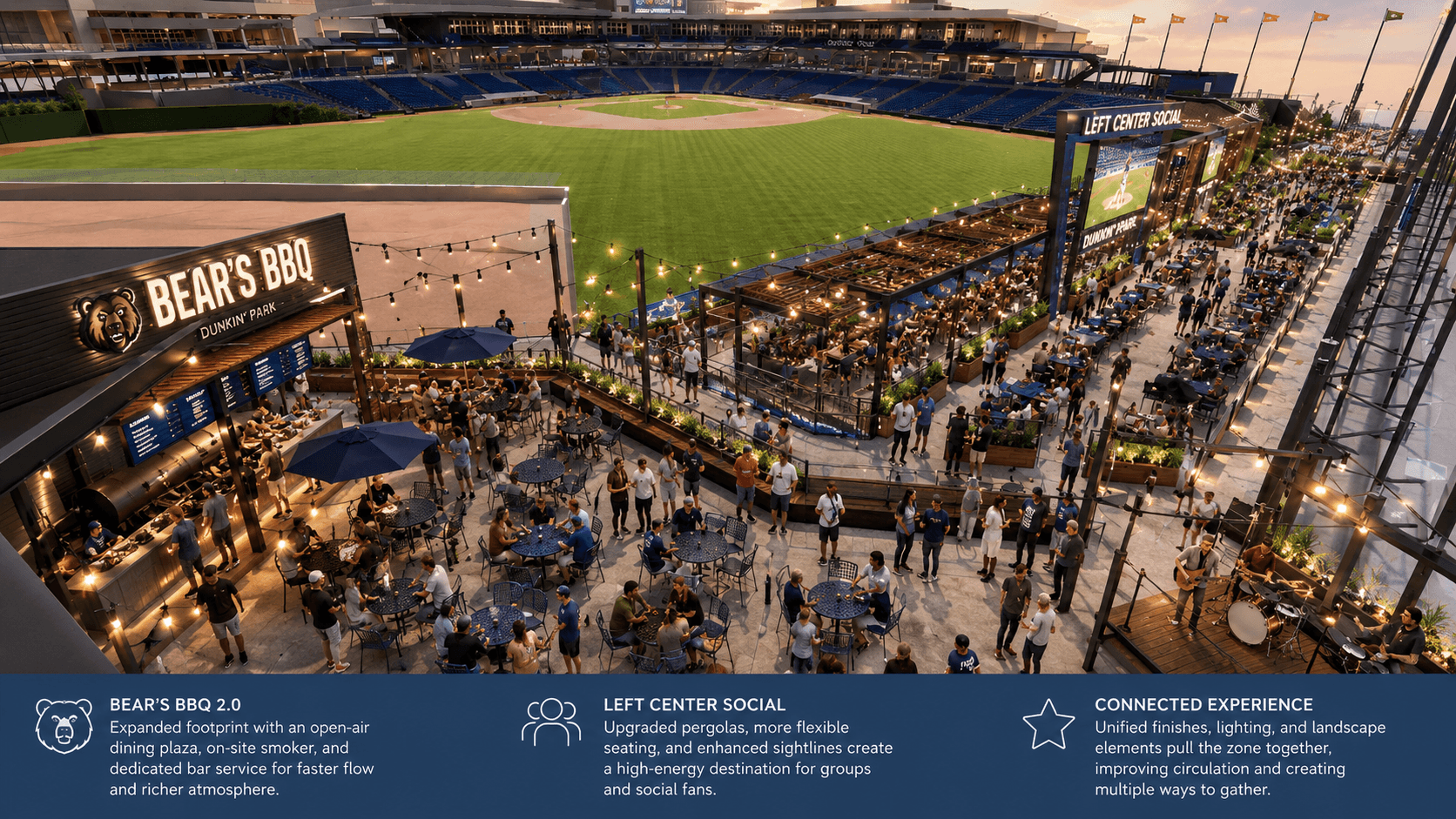
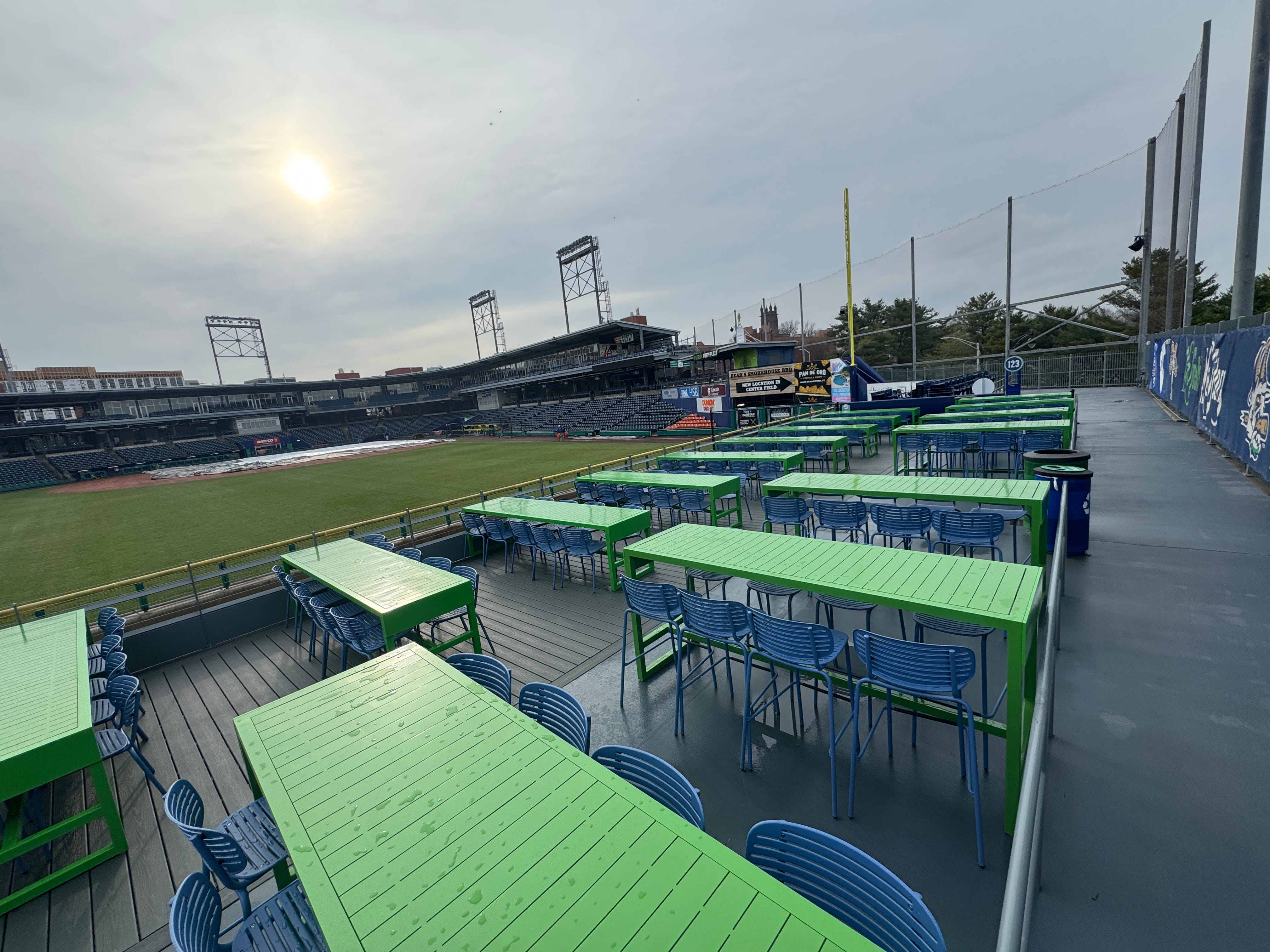
  history. “Dark Blues Diner” gives a nod to the Negro League team that played in Hartford in 1874 to 1876: The Hartford Dark Blues. “Huck’s Hot Corner” is a play on words honoring The Adventures of Huckleberry Finn, written by Samuel Clemons (Mark Twain) whose childhood home remains a historic landmark in Hartford. “The Whistle Stop” is a locomotive themed food cart that references the “New York, New Haven and Hartford Railroad Company” that operated in the New England region of the United States from 1872 to 1968. There’s “Reggae In Right” which is a food cart celebrating Hartford’s Caribbean culture. The cart, on the upper deck in right field, offers items from Scotts’ Jamaican Bakery, a family owned local business with deep Jamaican roots. Another local favorite is “Bear’s Smokehouse Barbecue” which occupies a purpose-built casual dining area in the left field corner. I can still remember the spirited design discussions with the team about the desire to create destinations on the concourse that contribute to the “emotional muscle memory” of the patrons. The plumes of BBQ scented smoke in the air, the sweet smell of Dunkin’ Donuts glaze… it’s all part of the experience that generates a time stamp in our minds, it’s these sensory memories that keep us coming back to the ballpark. The traditional peanuts, popcorn and Cracker Jack offerings will never be replaced but the emergence of innovative and regional options is a definite move toward the future.
At 7:30PM I headed toward the outfield group areas. Along the way I stopped off at the Beer bat stand. This is an added feature this season and another example of the Yard Goats’ willingness to enhance the fan experience by collaborating with local business. A local cup company that uses architects to design interesting vessels for drinks in Las Vegas pitched the Goats on cups shaped like everything from goats to trash cans as a novelty item. Yard Goats President and 2017 Eastern League Executive of the Year Tim Restall said, “what about a full size bat?”. The rest is history… and people are absolutely loving it! $9 buys an empty bat, $19 buys a bat full of beer, and you can refill the bat for $10. The promotion was such a hit that people who purchased a bat on a Monday returned later in the week on Thursday and kept the party going!
 As I walked around the left field foul pole, the group area right below the scoreboard is the first section of seating I encountered. That we chose to design the bowl without a grass seating berm feature is one of those decisions that many people questioned, but to this day I think was the right move. Dunkin’ Donuts Park is urban, so I’ve always thought about the seating bowl as a bunch of small neighborhoods. Home plate and behind the
  dugouts is where the baseball purists sit for an authentic experience. The third baseline just below “Bear’s BBQ Pit” is a super cool section of seating called “Dunkin’ Dugout” that the Yard Goats donate to community groups every game. The left field foul pole seats were always in our plan to be the rowdy section of the park. Technically speaking, the seats are only five feet above the playing field surface with only a wire mesh rail separating patrons from players.
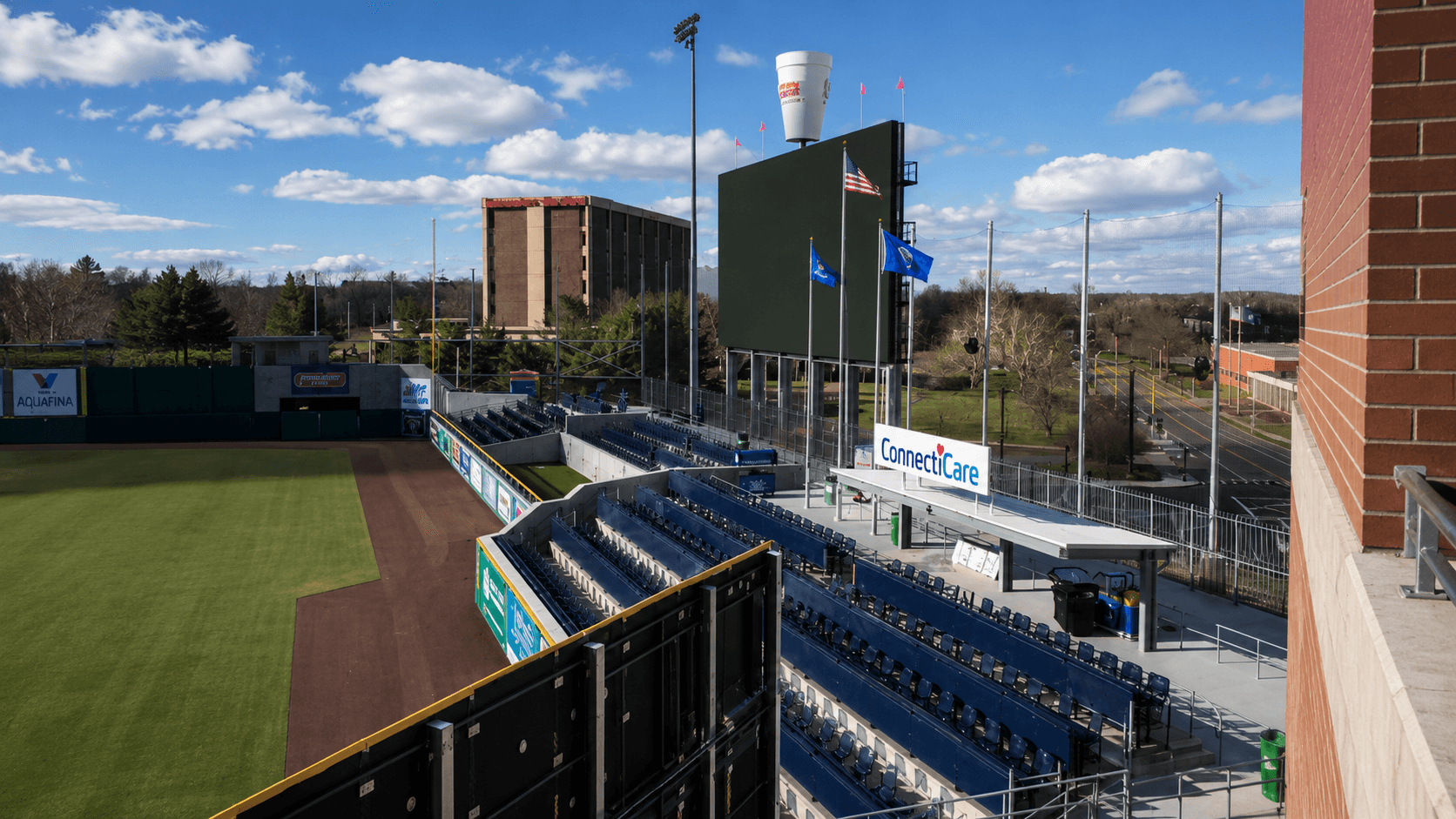
  This is next to the visitor bullpen that is just below the “Connecticare Picnic Pavilion” which terminates right into the center field batter’s eye. The entire outfield from the left field foul pole to the “Travelers Kids Fun Zone” was designed to
  feel totally different from behind home plate; it’s reminiscent of a smaller version of the outfield bleachers at Wrigley Field. When walking through “Travelers Kids Fun Zone” and heading towards right-center field the ballpark transforms to a double-deck area
  that again wraps itself around the home team bullpen (which is also visible from outside the secure line as you walk along Trumbull Street). This area was inspired by Fenway Park that very similarly exists within a very tight footprint. We emulated Fenway’s steel shapes and narrow concourses with the entire area of
  seating behind protective netting. Home runs that are hit in shallow right field must be hit over the 250’ long video display that serves as the edge of the approximately 650 fixed seats and open concourse, roughly 24’ above the playing field surface. At the end of the right field concourse directly behind the foul pole our stroll ended at the “Hanging Hills Short Porch”. We decided to poke fun at ourselves a bit for having such a short porch, so we ran the foul line all the way though the bar and up the wall.
 Before I headed upstairs to the upper right field seating I stopped off at “Sheriff Tim’s Patty Wagon” a freshly made burger stand that was added this season. This is located right below the elevated premium seating area I affectionately refer to as “The Knuckle”, which is technically called “The Hartford Terrace”. I still prefer “The Knuckle” but I get the sponsorship angle for sure. This is one of my favorite locations on the main concourse, entering the main gates of the park, it’s the first view of the field that hits you. This spot is flanked by the main stair tower that supports the massive “Dunkin’ Donuts Park” naming rights sign on the left, the “Retro Brand Team Store” on the right as well as the game day starting lineup. This is the best place to people watch and listen to conversations and reactions as
  people walk in and around the concourse. On that particular night I heard a gentleman, an obvious out-of-towner, say, “Wow! Hartford did it right! They didn’t overbuild, it’s not too big… it’s perfect!”. I think his read was right on point.
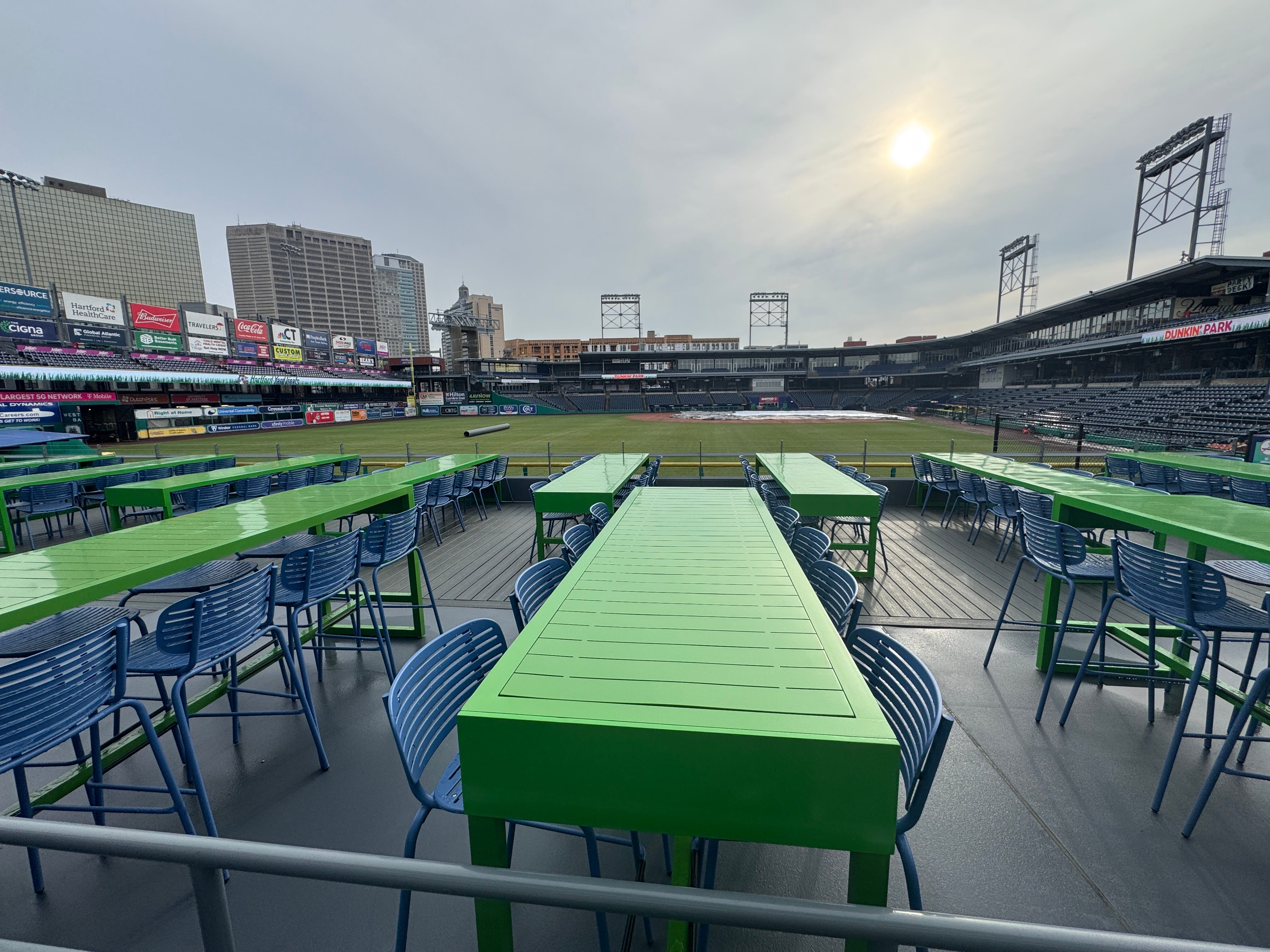
 It was time to navigate the final leg of my lap around the ballpark before heading to the Owner’s suite for a check in with the family and then back downstairs to the dugout suites to watch the annual end of season concert (more on that later). I always find it interesting to analyze the way patrons use the ballpark once construction is complete and I’ve moved on. Although we originally envisioned the right field upper deck seating as a means to an end to get to the right capacity, the area has actually become the hang out spot for young professionals. As I stood at the Budweiser standing tables that Tim Restall brilliantly added this season, I noticed a swarm of people arriving from the center field stair tower. They made a quick pit stop at the “Budweiser Sky Bar”, positioned directly above the batter’s eye screen, grabbed a drink at the bar and then circulated the upper concourse. This area is a heavily trafficked millennial haven that was my second favorite place to people watch and listen to casual conversation. By the time the game had progressed to the top of the seventh inning the upper concourse and seating was jam-packed, so much so that it became hard to see the field below due to the constant traffic and hordes of milling patrons. It was time to work my way to the Owner’s suite. It was perfect timing because the artist that was to perform the post-game concert had made their way to the suite and we stuck around for a bit talking about the music we grew up on.
 At the end of the 2017 season the Yard Goats booked hip hop legend Curtis Blow,2018 year they had a double feature of Black Sheep and DJ Kool. It’s endearing to me that the team is 100% in tune with the surrounding community. We’ve all worked with people in the business with “attitudes” and that’s absolutely not what we’re talking about with team owner Josh Solomon and his family. Josh is tough, a business man, but fair, authentic and genuine. He surrounds himself with like-minded people and I appreciate that. There were many times during the stadium design that we had tough conversations (real talk), direct conversations, and sometimes weird stressful situations based on the goings on of the project that are well documented in the local Hartford news journals. Even so, we always had respect amongst the group and a genuine desire to extract the absolute best out of everyone involved in the project.
The post-game concert was a blast! The crowd was engaged and the artist was exactly like I remembered: seasoned veterans of the game with the ability to move the crowd with classic hip hop tunes… an incredible way to end the season. The Yard Goats didn’t make the playoffs but honestly, I don’t think it really matters. The citizens of Hartford came out and supported the home team, selling out seven more games than the season before and I’d be willing to bet money that they’ll sell out at least ten more games in 2019… that’s how much I believe in the people behind the brand. I can honestly say without hesitation that I am still in love with every inch of Dunkin’ Donuts Park. To be clear: it’s not just because I designed it, this feeling is much bigger than that. It’s the staff, the community, the passion of the ownership, it’s their willingness to put themselves out there every game and present themselves as just that much better than their counterparts. I will forever be a fan.
So to the good folks within the Yard Goat organization, have a great season…keep breaking records. It’s no mistake that “The Dunk” was voted best ballpark 2017 and 2018. The 2019 season is upon us – let’s get it!
Credits:
Lee Frommelt: Copy Editor
The Hartford Yard Goats: Community Advocates
Photography: Robert Benson Photography