
By: Jonathan O’Neil Cole, AIA, NCARB, NOMA
Pendulum Studio
Executive Summary
Stadiums Created with Operationally Resilient Economics (S.C.O.R.E.) is a performance-based design framework developed by Jonathan O’Neil Cole, AIA, NCARB, NOMA, of Pendulum Studio. It advances architectural practice by integrating creativity, technology, and data to measure how design contributes to environmental, economic, and social outcomes. Building on the foundation established in Ballpark Design for the Future (Pendulum Studio, 2014), the framework translates design intent into measurable performance through continuous evaluation and feedback.
S.C.O.R.E. aligns with the AIA Framework for Design Excellence by organizing its ten measures into five domains: Strategy, Creativity, Operations, Research, and Experience. Each domain focuses on quantifiable aspects of design performance such as equity, efficiency, sustainability, and user well-being. The methodology is particularly suited for stadiums and civic venues where scale, occupancy, and operational complexity require a high level of coordination and accountability.
Recognizing that USGBC LEED v4 certification can be cost-prohibitive for projects ranging from $10 million to $100 million, S.C.O.R.E. applies equivalent rigor through a more flexible, data-driven process. The framework integrates tools such as BIM coordination, energy modeling, and life-safety simulation to provide transparent and verifiable performance metrics without the administrative burden of formal certification.
The Meritus Park project in Hagerstown, Maryland, demonstrates the framework’s effectiveness. Developed on a reclaimed brownfield site, the stadium reconnected neighborhoods through accessible pedestrian corridors, community spaces, and adaptive programming. Independent analysis verified outcomes consistent with LEED v4 Silver performance, including a 51.29 percent energy improvement, 26 percent water reduction, and 68.6 percent waste diversion. A timed egress simulation confirmed full evacuation within 14.6 minutes in compliance with NFPA 101 standards. The project’s design and programming have contributed to renewed downtown activity and community engagement.
S.C.O.R.E. positions architecture as both an art and a measurable science. By linking design excellence with operational data and economic value, it provides a pathway for architects, developers, and municipalities to achieve more resilient, equitable, and accountable built environments.
Architecture for Resilient Economies
Architecture today is defined not only by creativity but by accountability. Designers must demonstrate how each project performs economically, environmentally, and socially over time. S.C.O.R.E., Stadiums Created with Operationally Resilient Economics was developed to meet that demand. It ensures that every design move contributes to measurable outcomes that enhance community value and operational resilience.
At Pendulum Studio, S.C.O.R.E. turns design into a continuous process of learning and refinement. It merges technology, creativity, and financial strategy to ensure that civic spaces, especially stadiums, become sustainable engines of growth rather than single-use venues.

The S.C.O.R.E. Framework
The American Institute of Architects (AIA) Framework for Design Excellence defines ten measures that guide the profession’s responsibility to human and environmental well-being: Integration, Equitable Communities, Ecosystems, Water, Economy, Energy, Well-being, Resources, Change, and Discovery. These principles form the foundation of design excellence, promoting architecture that advances sustainability, inclusivity, and resilience.
S.C.O.R.E., which stands for Stadiums Created with Operationally Resilient Economics, builds directly upon this foundation. It does not replace the AIA Framework but distills it into a focused system designed specifically for stadiums and large civic venues. These facilities present unique challenges, mass gatherings, variable occupancy, significant environmental impact, and enduring civic visibility. They must perform across physical, economic, and cultural dimensions.
Despite LEED v4’s status as a robust and globally recognized green building standard, its adoption by private developers and municipalities, particularly for mid-scale projects in the $10 million to $100 million range, remains modest. A primary barrier is cost: beyond registration and certification fees, which scale with building size and review complexity, projects often incur additional “soft” costs for coordination, documentation, specialty consultants, and performance modeling. These added expenses can represent 1 to 5 percent of total project budgets, making LEED less appealing in tightly constrained financial models. Municipal and private stakeholders often lack institutional capacity or incentives, such as dedicated sustainability staff or long-term operating budgets, to manage the complex documentation, verification process, and ongoing performance tracking that LEED requires.
Academic research also indicates that LEED adoption varies regionally, with project teams often focusing on easier credits rather than holistic performance, suggesting that the system’s procedural demands can discourage deeper implementation. In many cases, decision makers prioritize short-term returns or simpler compliance paths over certification when they cannot directly realize or recoup long-term operational benefits. Within this context, S.C.O.R.E. provides a more targeted and scalable technical framework for integrating performance metrics, life-safety modeling, and financial analytics into design practice, reducing administrative overhead and aligning more closely with stakeholder interests in accountability, adaptability, and measurable resilience.
Correlation Between the AIA Framework and the S.C.O.R.E. Domains
The following summary illustrates how the AIA’s ten measures of Design Excellence are distilled into the five interdependent domains of the S.C.O.R.E. framework. This mapping clarifies how broad architectural principles are transformed into operational strategies specific to stadium design and civic infrastructure.
| AIA Principle | Corresponding S.C.O.R.E. Domain(s) |
| 1. Integration | Strategy, Creativity, Operations |
| 2. Equitable Communities | Strategy, Experience |
| 3. Ecosystems | Strategy, Operations, Research |
| 4. Water | Operations, Research |
| 5. Economy | Strategy, Operations |
| 6. Energy | Operations, Research |
| 7. Well-being | Creativity, Experience |
| 8. Resources | Operations, Research |
| 9. Change | Strategy, Operations, Research |
| 10. Discovery | Research, Experience |
Through this correlation, Stadiums Created with Operationally Resilient Economics becomes a practical extension of the AIA Framework, refining its universal measures into a system that accounts for the complexity and civic importance of stadiums. It ensures that each design decision contributes to measurable outcomes in sustainability, safety, financial performance, and public experience.
In doing so, S.C.O.R.E. reinforces the AIA’s vision of design excellence while providing a clear roadmap for how stadium architecture can perform as both a civic asset and an enduring economic catalyst.
Translating AIA Design Excellence to Stadiums Created with Operationally Resilient Economics
Stadiums Created with Operationally Resilient Economics (S.C.O.R.E.) builds on the AIA Framework for Design Excellence and organizes its ten measures into five interrelated domains that address the unique challenges of stadium architecture. Each domain reflects a balance of social value, environmental performance, and operational resilience, defining how civic venues can achieve measurable, enduring impact.
- S – Integration & Equity
Focuses on the coordination of people, place, and purpose. It emphasizes equitable access, stakeholder engagement, and community representation throughout the design process, ensuring that every project outcome strengthens civic inclusion and social balance. - C – Community-Driven Design
Encourages participatory planning, cultural relevance, and long-term adaptability. This domain aligns design vision with local identity and collective benefit, positioning stadiums as platforms for year-round civic activation. - O – Wellness & Functionality
Addresses user experience, comfort, and environmental quality. It integrates health-focused design strategies—such as daylighting, air quality, and universal accessibility—to support both occupant wellness and operational performance. - R – Ecology, Energy, and Water
Centers on sustainable resource management and environmental stewardship. It measures performance across energy efficiency, water conservation, and material life cycles, ensuring stadiums contribute positively to their ecological context. - E – Economy & Return on Investment
Links design excellence to fiscal responsibility. This domain evaluates long-term operational efficiency, maintenance strategies, and community return, confirming that resilient design also delivers economic value.
- S – Integration & Equity
Through these five domains, S.C.O.R.E. creates a measurable bridge between design intent and realized performance, defining how architecture can simultaneously serve people, place, and prosperity.
This distillation allows the AIA’s broad measures to operate within the specialized context of stadium design, where environmental stewardship, operational resilience, and economic impact converge.
Case Study: Meritus Park – Hagerstown, Maryland (2024 & 2025 Atlantic League Ballpark of the Year)

Project Description
Meritus Park stands at the heart of downtown Hagerstown, Maryland, as a contemporary example of how civic architecture can reconnect history, culture, and community. The project occupies land that once housed Hagerstown’s first train station in the early twentieth century, a site that later became a light-industrial corridor as rail infrastructure expanded throughout the region. By the twenty-first century, this area had fallen into disuse, characterized by surface parking and vacant industrial buildings. The redevelopment of this site into a civic ballpark represents the city’s strategic reinvestment in its urban core and its industrial heritage.
For more than a century, Hagerstown has been a baseball town. Professional teams such as the Hubs, Owls, Braves, Packets, and later the Suns defined local identity and community gathering. From 1930 until 2019, Municipal Stadium served as the home for affiliated minor-league baseball and stood as a touchstone for civic life. Following the stadium’s demolition in 2022, the city sought to preserve its baseball legacy while reimagining how a ballpark could serve as an engine of downtown renewal. Meritus Park, which opened in May 2024, achieves that balance by combining heritage with innovation.

The stadium’s design integrates seamlessly into Hagerstown’s historic urban fabric. It reconnects adjacent neighborhoods through improved pedestrian corridors and a realigned segment of the Chesapeake & Ohio (C&O) Canal National Heritage Trail. The trail now flows directly through the site, linking the ballpark to downtown streets, the Arts & Entertainment District, and the Washington County Museum of Fine Arts. This new configuration enhances visibility, safety, and accessibility, transforming what was once a neglected edge of downtown into an active civic gateway.
Before redevelopment, pedestrian activity within the project area was limited primarily to daytime office use, with sparse evening and weekend traffic. Since the ballpark’s completion, preliminary observations suggest increased downtown pedestrian activity, particularly along West Baltimore and Summit Avenue. Local businesses have reported an increase in walk-in sales on event days, and the public spaces surrounding the park now host daily users even outside scheduled events. Meritus Park’s adjacency to residential and cultural districts has extended the rhythm of downtown life beyond the traditional nine-to-five window, creating a sense of continuity between civic, commercial, and recreational functions.
Public safety is an essential dimension of the park’s community impact. Prior to redevelopment, Hagerstown’s violent crime rate stood at approximately 712 incidents per 100,000 residents, significantly higher than the Maryland and U.S. averages. Concurrently, Washington County recorded a 22 percent year-over-year reduction in fatal overdoses, signaling broader improvement in community health and engagement. While it is too early to attribute specific outcomes directly to the new stadium, the project has introduced conditions that research associates with safer urban environments: consistent activation, enhanced lighting, and “eyes on the street.” The Hagerstown Police Department has partnered with the city to monitor incident data around the stadium through public reporting tools such as CityProtect, providing a transparent foundation for evaluating long-term impacts.
Beyond its physical footprint, Meritus Park serves as a platform for civic participation. The venue operates as a multi-use destination, hosting concerts, festivals, markets, and educational programming in addition to professional baseball. These events have diversified downtown visitation patterns, strengthened local business exposure, and supported Hagerstown’s broader City Center revitalization strategy. The project exemplifies how intentional design and community-oriented programming can transform an underused industrial site into an inclusive civic catalyst.

Meritus Park demonstrates that architecture, when informed by history and guided by community purpose, can foster measurable improvements in urban vitality. It honors Hagerstown’s cultural roots while shaping its future, illustrating the potential for thoughtful redevelopment to unify heritage, accessibility, safety, and shared civic identity.
The aerial perspective of Meritus Park illustrates how the stadium serves as both civic infrastructure and cultural catalyst. Positioned on a reclaimed brownfield within downtown Hagerstown, it anchors a network of parks, pedestrian corridors, and local businesses. The design embodies AIA’s call for architecture that strengthens community resilience through adaptive reuse, economic stimulation, and environmental stewardship.

The accompanying S.C.O.R.E. performance dashboard (above) visualizes Meritus Park’s comprehensive evaluation under the five design pillars: Strategy, Creativity, Operations, Research, and Experience. The project achieved a composite score of 43, classifying it as an Exemplary Project-a quantifiable benchmark that links architectural quality with operational, environmental, and community outcomes. This measurable framework aligns with the American Institute of Architects (AIA) ‘Design for Integration’ principle by demonstrating how design excellence can be both creative and accountable.
Meritus Park: A Living Model of Operationally Resilient Economics
Meritus Park exemplifies the S.C.O.R.E. Framework in full application. Built on a reclaimed brownfield site, the project transformed underutilized land into a center for civic engagement. It combines sustainability, technology, and social activation into one cohesive design system.
The project achieved 57 points under the LEED v4 system, equivalent to Silver-level performance. Key metrics include a 51.29 percent energy improvement over baseline, a 26 percent indoor water-use reduction, and 75 percent stormwater capture. Materials tracking documented 57 Environmental Product Declarations (EPDs) and a 68.6 percent waste diversion rate. Each of these outcomes was validated through independent LEED review, providing quantifiable evidence of performance.
Beyond the numbers, Meritus Park proves how sustainability supports economics. Reduced operating costs, enhanced comfort, and consistent community engagement all contribute to long-term viability. The project’s design also prioritized local labor and materials, ensuring that financial investment stayed within the community.

This LEED v4 performance data supports the S.C.O.R.E. framework’s quantifiable impact. Each category-energy, water, materials, and community connectivity-directly aligns with the AIA’s ten measures of Design Excellence, providing verifiable evidence of performance and sustainability.
Meritus Park – Sustainability Performance Summary (LEED v4):
| Category | Achievement | Points |
| Integrative Process | Achieved synergies between energy and water modeling, resulting in 51.29% energy cost reduction and elimination of permanent irrigation systems. | 1 |
| Location and Transportation | Redeveloped urban brownfield site within city core; High Priority Site in Qualified Census Tract; Walk Score 83; six bus routes within ¼ mile; 60% reduced parking footprint; 6 EV-ready spaces. | 10 |
| Sustainable Sites | Full compliance with erosion and sediment control plan; heat island reduction via high-reflectance roofing and paving; construction pollution prevention and stormwater management achieved. | 2 |
| Water Efficiency | No permanent irrigation system; 26.08% indoor water use reduction through low-flow fixtures and fittings; building-level water metering installed per LEED prerequisite. | 3 |
| Energy and Atmosphere | Enhanced and envelope commissioning; 51.29% energy performance improvement over ASHRAE baseline; building-level energy metering; non-CFC refrigerants; fundamental commissioning achieved. | 24 |
| Materials and Resources | 57 Environmental Product Declarations (EPDs); 10 products with embodied carbon optimization; 48.5 products with ingredient disclosure; 68.61% construction waste diversion via 5 streams; recycling plan implemented. | 5 |
| Indoor Environmental Quality | CO₂ monitoring in all densely occupied interior spaces; 100% low-emitting paints, coatings, adhesives, ceilings, and wall panels; thermal comfort per ASHRAE 55; construction IAQ plan and tobacco smoke control enforced. | 6 |
| Innovation | Exemplary reduced parking (60% below base ratio); exemplary low-emitting materials (≥90% compliance in 4 categories); LEED AP BD+C involvement for project delivery. | 3 |
| Regional Priority | Enhanced Commissioning; Sensitive Land Protection; Surrounding Density and Diverse Uses achieved regional priority thresholds for sustainability leadership. | 3 |
Total Achieved Points: 57 (Equivalent to LEED Silver Level under LEED v4 BD+C: New Construction and Major Renovation).
All 12 prerequisites satisfied, including commissioning, refrigerant management, water and energy metering, and tobacco smoke control, as verified by Elevar Design Group LEED documentation and final scorecard.
This combination of data and design demonstrates how S.C.O.R.E. converts architectural ideals into measurable performance. It proves that a well-designed stadium is not a cost center but an enduring community investment.
Although the owner of the facility required Meritus Park be designed to a USGBC LEED v4 Silver minimum as well as enhanced building envelope commissioning, they chose not to pursue formal USGBC certification.
Meritus Park – Life Safety and Technical Validation
Technical performance extends beyond environmental metrics. Pendulum’s integration of life safety modeling into S.C.O.R.E. reinforces its value as a framework for technical advancement. For Meritus Park, a comprehensive Life Safety Evaluation and Timed Egress Analysis were conducted to verify compliance with NFPA 101 Life Safety Code and International Building Code (IBC) standards.
The stadium’s Type II-B construction with full sprinkler coverage and open-air design provides inherent fire protection and occupant safety. Timed egress simulations confirmed that under maximum occupancy, total evacuation time was 14.6 minutes-well within the NFPA 101 threshold of 20 minutes. Exit width, stair capacities, and travel distances were analyzed using computational modeling to ensure that all occupants could evacuate safely without congestion or delay.
This level of validation exemplifies the technical precision embedded in S.C.O.R.E. It treats life safety as a design performance metric, not a compliance checkbox. By combining code analysis, simulation, and real-world testing, Pendulum advances architecture into a data-driven, predictive science.
In alignment with the AIA Framework for Design Excellence, which calls for architects to create environments that are safe, adaptable, and resilient, Jonathan O’Neil Cole elevates life safety from a baseline requirement to a measurable design performance metric. His S.C.O.R.E. methodology integrates technical modeling, timed egress simulations, and post-occupancy evaluation within the design process, setting a new standard for transparency and rigor in stadium architecture.
Meritus Park – Economic Sustainability as Design Intelligence

S.C.O.R.E. advances sustainability through the lens of economics. Operational resilience-efficient energy use, optimized maintenance, and community activation-translates directly into financial durability. At Meritus Park, these efficiencies lowered annual operating costs and extended system lifespans, proving that environmental responsibility and economic performance are inseparable.
Jonathan O’Neil Cole’s methodology aligns financial modeling with architectural design, establishing a new standard for how architects define value. S.C.O.R.E. demonstrates that data, design, and discipline can produce environments that perform for both people and profit.
Together, the S.C.O.R.E. metrics dashboard and Meritus Park’s built reality demonstrate the future of data-informed design practice: architecture that unites creativity with proof of performance, inspiring confidence among clients, stakeholders, and communities.
Conclusion: Architecture That Proves Its Value
S.C.O.R.E., or Stadiums Created with Operationally Resilient Economics, embodies Pendulum Studio’s belief that great design must be both visionary and verifiable. Developed by Jonathan O’Neil Cole, the framework transforms architectural creativity into measurable intelligence and civic value.
Meritus Park exemplifies this philosophy. Its performance, 57 verified LEED v4 points, a 51.29 percent energy improvement, and a 14.6-minute total egress time under full occupancy, demonstrates that design can achieve quantifiable results in resilience, safety, and sustainability. These are not incidental metrics; they are evidence of intentional, accountable design.
S.C.O.R.E. translates the American Institute of Architects (AIA) Framework for Design Excellence into action. It embodies the AIA’s focus on Integration, Well-being, and Change through measurable systems of strategy, creativity, operations, research, and experience. This alignment bridges human experience and technical precision, positioning design as a catalyst for both social and economic advancement.
Through this methodology, Cole demonstrates the architect’s role as a steward of performance. S.C.O.R.E. ensures that civic venues, particularly stadiums, evolve beyond entertainment spaces to become engines of urban renewal, drivers of local economies, and models of technical and environmental excellence.
Ultimately, S.C.O.R.E. demonstrates that design excellence can be quantified and taught. It demonstrates that beauty and accountability can coexist when design is guided by purpose, data, and human-centered outcomes. Under Jonathan O’Neil Cole’s leadership, Pendulum Studio continues to advance architecture as both an art and a science, delivering work that performs, endures, and creates lasting value.
Additional Pendulum Projects Completed with the S.C.O.R.E. Methodology
Neuroscience Group Field – Appleton, Wisconsin (Renovation 2013 & 2023)
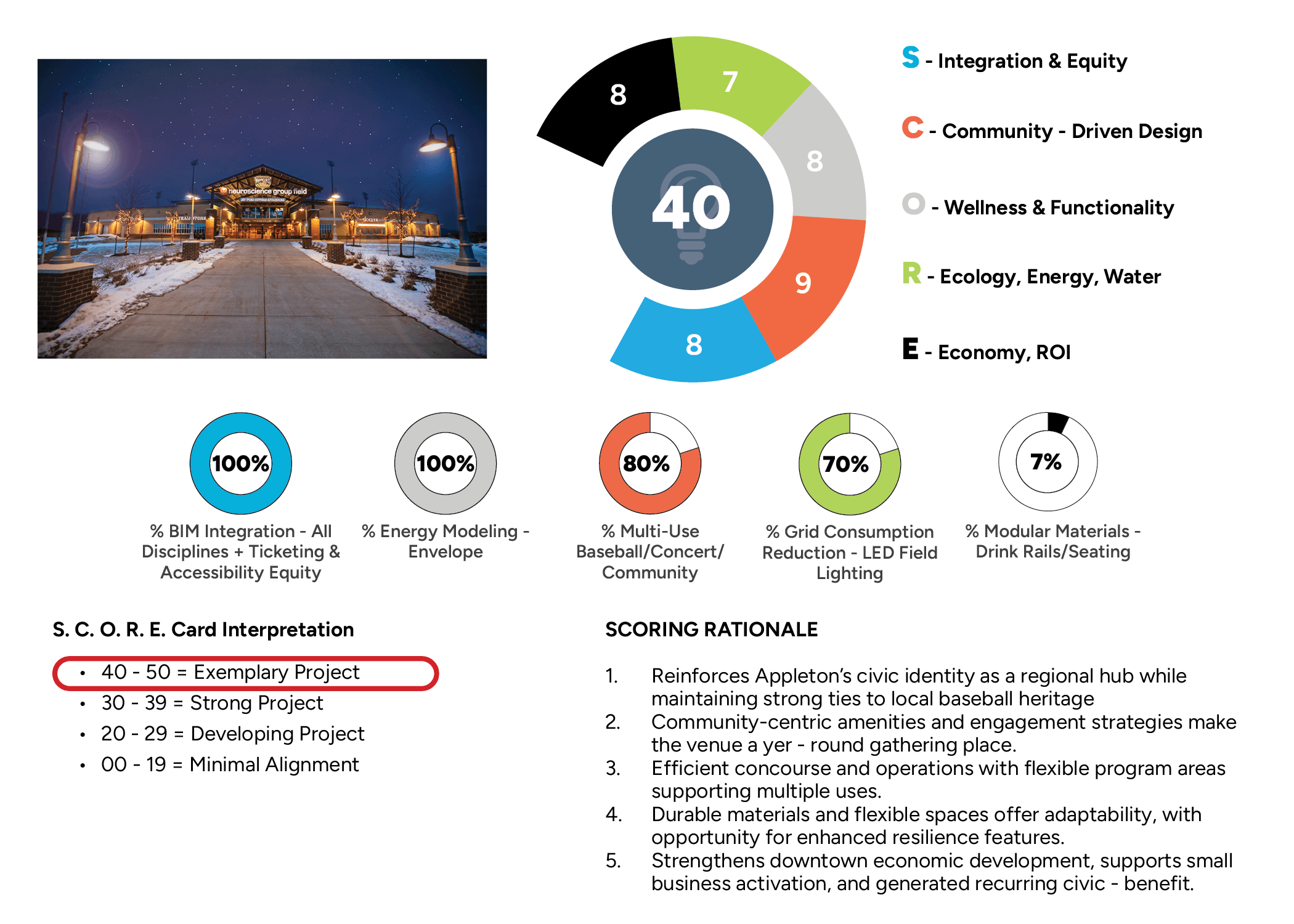
Dunkin’ Park – Hartford, Connecticut (Completed 2017)

Cool Today Park – North Port, Florida (Completed 2019)

Up Next: WiSE Stadium – Wilson, North Carolina (Scheduled Completion 2026)


About the Author: Jonathan O’Neil Cole and the Future of Design Economics
Jonathan O’Neil Cole, AIA, NCARB, NOMA, is the founding principal of Pendulum Studio. He developed the S.C.O.R.E. Framework to align architectural creativity with technical, operational, and economic sustainability. Cole’s approach challenges architects to move beyond form-making and embrace a future where design, data, and resilience define true excellence.
Sources & References
Primary Works by Jonathan O’Neil Cole
- Cole, Jonathan O’Neil. The S.C.O.R.E. Framework: Architectural Intelligence in Practice. Pendulum Studio, 2025.
- Cole, Jonathan O’Neil. Ballpark Design for the Future. Pendulum Studio, 2014.
Technical and Sustainability References
- The American Institute of Architects (AIA). Framework for Design Excellence. AIA.org, 2023.
- United States Green Building Council (USGBC). LEED v4 BD+C: New Construction and Major Renovation Reference Guide. Washington, D.C.: USGBC, 2024.
- Elevar Design Group. LEED v4 Documentation and Final Scorecard: Hagerstown Multi-Use Sports & Events Facility. 2024.
- FP&C Consultants. Life Safety Evaluation Report and Timed Egress Analysis for the Hagerstown Multi-Use Sports & Events Facility, 2024.
- Pedestrian Wind Comfort and Stadium Microclimate Design. RWDI.com, 2022.
- Buro Happold. Sports Venue Design and Environmental Modeling. BuroHappold.com, 2021.
- International Code Council (ICC). International Building Code (IBC). 2021 Edition.
- National Fire Protection Association (NFPA). NFPA 101: Life Safety Code. 2021 Edition.
Economic and Policy Context
- United States Department of the Treasury. New Markets Tax Credit (NMTC) Program Overview. CDFIFund.gov, 2023.
- org. “Tax Increment Financing.” Definition and Explanation of Mechanism. Accessed 2024.
- Community Renewal Tax Relief Act of 2000. Public Law 106–554, 114 Stat. 2763.
Industry Research and Precedent Studies
- Stadium Development Trends and Design Innovation Report. Populous.com, 2022.
- Sports Business Journal. “The Evolution of Sports Venue Economics.” 2023.
- Major League Baseball (MLB). Green Sports Alliance Sustainability Report. MLB.com, 2023.
- Minor League Baseball (MiLB). Facility Standards and Design Guidelines. 2023 Edition.
Academic and Professional Frameworks
- The American Institute of Architects. Design for Integration: Linking Creativity and Performance. 2023.
Public Safety
- Maryland Stadium Authority. Hagerstown Multi-Use Sports and Events Facility Project Overview. 2024.
- City of Hagerstown. Downtown Revitalization and Safety Operations Plan. 2024.
- Hagerstown Police Department. CityProtect Crime Mapping Portal. 2024.
- Washington County Health Department. Public Health Report: Overdose Trends. April 2024.
- Hagerstown, MD Crime Statistics. 2023.
- Hagerstown Crime Overview. 2023.
- Hagerstown Arts & Entertainment District. Cultural Trail Connectivity Map and Master Plan. 2023.
- Baseball Reference. Hagerstown Baseball History and Team Lineage. Accessed 2024.
- Maryland Historical Trust. Hagerstown Historic District Inventory. 2022.
Photo Credits
- Dunkin’ Park – Robert Benson Photography
- Meritus Park (Aerial View) – Eric Hastings
- Meritus Park (Field View) – Turner Construction
- Cool Today Park – Atlanta Braves
Related Articles
WISCONSIN TIMBER RATTLERS ANNOUNCE BALLPARK IMPROVEMENTS FOR 2023
Dunkin’ Donuts Park Opening Day – Yes…We’re Still In Love With The Ballpark
You must be logged in to post a comment.