Design Intelligence in Practice: S.C.O.R.E. – Stadiums Created with Operationally Resilient Economics

By: Jonathan O’Neil Cole, AIA, NCARB, NOMA
Pendulum Studio

Executive Summary

Stadiums Created with Operationally Resilient Economics (S.C.O.R.E.) is a performance-based design framework developed by Jonathan O’Neil Cole, AIA, NCARB, NOMA, of Pendulum Studio. It advances architectural practice by integrating creativity, technology, and data to measure how design contributes to environmental, economic, and social outcomes. Building on the foundation established in Ballpark Design for the Future (Pendulum Studio, 2014), the framework translates design intent into measurable performance through continuous evaluation and feedback.

S.C.O.R.E. aligns with the AIA Framework for Design Excellence by organizing its ten measures into five domains: Strategy, Creativity, Operations, Research, and Experience. Each domain focuses on quantifiable aspects of design performance such as equity, efficiency, sustainability, and user well-being. The methodology is particularly suited for stadiums and civic venues where scale, occupancy, and operational complexity require a high level of coordination and accountability.

Recognizing that USGBC LEED v4 certification can be cost-prohibitive for projects ranging from $10 million to $100 million, S.C.O.R.E. applies equivalent rigor through a more flexible, data-driven process. The framework integrates tools such as BIM coordination, energy modeling, and life-safety simulation to provide transparent and verifiable performance metrics without the administrative burden of formal certification.

The Meritus Park project in Hagerstown, Maryland, demonstrates the framework’s effectiveness. Developed on a reclaimed brownfield site, the stadium reconnected neighborhoods through accessible pedestrian corridors, community spaces, and adaptive programming. Independent analysis verified outcomes consistent with LEED v4 Silver performance, including a 51.29 percent energy improvement, 26 percent water reduction, and 68.6 percent waste diversion. A timed egress simulation confirmed full evacuation within 14.6 minutes in compliance with NFPA 101 standards. The project’s design and programming have contributed to renewed downtown activity and community engagement.

S.C.O.R.E. positions architecture as both an art and a measurable science. By linking design excellence with operational data and economic value, it provides a pathway for architects, developers, and municipalities to achieve more resilient, equitable, and accountable built environments.


Architecture for Resilient Economies

Architecture today is defined not only by creativity but by accountability. Designers must demonstrate how each project performs economically, environmentally, and socially over time. S.C.O.R.E., Stadiums Created with Operationally Resilient Economics was developed to meet that demand. It ensures that every design move contributes to measurable outcomes that enhance community value and operational resilience.

At Pendulum Studio, S.C.O.R.E. turns design into a continuous process of learning and refinement. It merges technology, creativity, and financial strategy to ensure that civic spaces, especially stadiums, become sustainable engines of growth rather than single-use venues.

Circular infographic titled “S.C.O.R.E.” which stands for “Stadiums Created with Operational Resilient Economics.” The circle is divided into five color-coded segments, each representing a pillar: • S (blue): Integration & Equity • C (orange): Community-Driven Design • O (gray): Wellness & Functionality • R (green): Ecology, Energy, Water • E (black): Economy, ROI At the center of the circle is a dark blue inner ring with a light bulb icon and the number “50” in white.

The S.C.O.R.E. Framework

The American Institute of Architects (AIA) Framework for Design Excellence defines ten measures that guide the profession’s responsibility to human and environmental well-being: Integration, Equitable Communities, Ecosystems, Water, Economy, Energy, Well-being, Resources, Change, and Discovery. These principles form the foundation of design excellence, promoting architecture that advances sustainability, inclusivity, and resilience.

S.C.O.R.E., which stands for Stadiums Created with Operationally Resilient Economics, builds directly upon this foundation. It does not replace the AIA Framework but distills it into a focused system designed specifically for stadiums and large civic venues. These facilities present unique challenges, mass gatherings, variable occupancy, significant environmental impact, and enduring civic visibility. They must perform across physical, economic, and cultural dimensions.

Despite LEED v4’s status as a robust and globally recognized green building standard, its adoption by private developers and municipalities, particularly for mid-scale projects in the $10 million to $100 million range, remains modest. A primary barrier is cost: beyond registration and certification fees, which scale with building size and review complexity, projects often incur additional “soft” costs for coordination, documentation, specialty consultants, and performance modeling. These added expenses can represent 1 to 5 percent of total project budgets, making LEED less appealing in tightly constrained financial models. Municipal and private stakeholders often lack institutional capacity or incentives, such as dedicated sustainability staff or long-term operating budgets, to manage the complex documentation, verification process, and ongoing performance tracking that LEED requires.

Academic research also indicates that LEED adoption varies regionally, with project teams often focusing on easier credits rather than holistic performance, suggesting that the system’s procedural demands can discourage deeper implementation. In many cases, decision makers prioritize short-term returns or simpler compliance paths over certification when they cannot directly realize or recoup long-term operational benefits. Within this context, S.C.O.R.E. provides a more targeted and scalable technical framework for integrating performance metrics, life-safety modeling, and financial analytics into design practice, reducing administrative overhead and aligning more closely with stakeholder interests in accountability, adaptability, and measurable resilience.

Correlation Between the AIA Framework and the S.C.O.R.E. Domains

The following summary illustrates how the AIA’s ten measures of Design Excellence are distilled into the five interdependent domains of the S.C.O.R.E. framework. This mapping clarifies how broad architectural principles are transformed into operational strategies specific to stadium design and civic infrastructure.

AIA PrincipleCorresponding S.C.O.R.E. Domain(s)
1. IntegrationStrategy, Creativity, Operations
2. Equitable CommunitiesStrategy, Experience
3. EcosystemsStrategy, Operations, Research
4. WaterOperations, Research
5. EconomyStrategy, Operations
6. EnergyOperations, Research
7. Well-beingCreativity, Experience
8. ResourcesOperations, Research
9. ChangeStrategy, Operations, Research
10. DiscoveryResearch, Experience

Through this correlation, Stadiums Created with Operationally Resilient Economics becomes a practical extension of the AIA Framework, refining its universal measures into a system that accounts for the complexity and civic importance of stadiums. It ensures that each design decision contributes to measurable outcomes in sustainability, safety, financial performance, and public experience.

In doing so, S.C.O.R.E. reinforces the AIA’s vision of design excellence while providing a clear roadmap for how stadium architecture can perform as both a civic asset and an enduring economic catalyst.

Translating AIA Design Excellence to Stadiums Created with Operationally Resilient Economics

Stadiums Created with Operationally Resilient Economics (S.C.O.R.E.) builds on the AIA Framework for Design Excellence and organizes its ten measures into five interrelated domains that address the unique challenges of stadium architecture. Each domain reflects a balance of social value, environmental performance, and operational resilience, defining how civic venues can achieve measurable, enduring impact.

    • S – Integration & Equity
      Focuses on the coordination of people, place, and purpose. It emphasizes equitable access, stakeholder engagement, and community representation throughout the design process, ensuring that every project outcome strengthens civic inclusion and social balance.
    • C – Community-Driven Design
      Encourages participatory planning, cultural relevance, and long-term adaptability. This domain aligns design vision with local identity and collective benefit, positioning stadiums as platforms for year-round civic activation.
    • O – Wellness & Functionality
      Addresses user experience, comfort, and environmental quality. It integrates health-focused design strategies—such as daylighting, air quality, and universal accessibility—to support both occupant wellness and operational performance.
    • R – Ecology, Energy, and Water
      Centers on sustainable resource management and environmental stewardship. It measures performance across energy efficiency, water conservation, and material life cycles, ensuring stadiums contribute positively to their ecological context.
    • E – Economy & Return on Investment
      Links design excellence to fiscal responsibility. This domain evaluates long-term operational efficiency, maintenance strategies, and community return, confirming that resilient design also delivers economic value.

Through these five domains, S.C.O.R.E. creates a measurable bridge between design intent and realized performance, defining how architecture can simultaneously serve people, place, and prosperity.

This distillation allows the AIA’s broad measures to operate within the specialized context of stadium design, where environmental stewardship, operational resilience, and economic impact converge.


Case Study: Meritus Park – Hagerstown, Maryland              (2024 & 2025 Atlantic League Ballpark of the Year)

A labeled aerial map titled “Predevelopment Site Plan” showing downtown Hagerstown, Maryland. The map highlights the future Meritus Park site in red near the intersection of West Baltimore Street and Summit Avenue. Yellow dashed arrows indicate the alignment of the historic trail connecting several key locations. Numbered blue circles mark sites identified in the legend: 01 – Hagerstown Housing Authority, 02 – Meritus Park Site, 03 – Harold Mail Building, 04 – Washington County Court House, 05 – District Court House, 06 – Washington County Library, and 07 – Historic Trail. The layout shows the site’s connection to surrounding civic, cultural, and public destinations.

Project Description

Meritus Park stands at the heart of downtown Hagerstown, Maryland, as a contemporary example of how civic architecture can reconnect history, culture, and community. The project occupies land that once housed Hagerstown’s first train station in the early twentieth century, a site that later became a light-industrial corridor as rail infrastructure expanded throughout the region. By the twenty-first century, this area had fallen into disuse, characterized by surface parking and vacant industrial buildings. The redevelopment of this site into a civic ballpark represents the city’s strategic reinvestment in its urban core and its industrial heritage.

For more than a century, Hagerstown has been a baseball town. Professional teams such as the Hubs, Owls, Braves, Packets, and later the Suns defined local identity and community gathering. From 1930 until 2019, Municipal Stadium served as the home for affiliated minor-league baseball and stood as a touchstone for civic life. Following the stadium’s demolition in 2022, the city sought to preserve its baseball legacy while reimagining how a ballpark could serve as an engine of downtown renewal. Meritus Park, which opened in May 2024, achieves that balance by combining heritage with innovation.

The image shows a predevelopment site plan for downtown Hagerstown, Maryland, using an aerial map to illustrate the location and surrounding context of the proposed Meritus Park site. The central area of the map is shaded red to identify the Meritus Park site near the intersection of West Baltimore Street and Summit Avenue. A dashed yellow line with arrows traces the alignment of the historic trail, connecting the park site to nearby civic and cultural landmarks. Blue numbered circles mark seven key locations that correspond to a legend on the right side of the image: 01 – Hagerstown Housing Authority, 02 – Meritus Park Site, 03 – Harold Mail Building, 04 – Washington County Court House, 05 – District Court House, 06 – Washington County Library, and 07 – Historic Trail. The map emphasizes how the redevelopment area links to major public institutions and pedestrian pathways within the urban core.

The stadium’s design integrates seamlessly into Hagerstown’s historic urban fabric. It reconnects adjacent neighborhoods through improved pedestrian corridors and a realigned segment of the Chesapeake & Ohio (C&O) Canal National Heritage Trail. The trail now flows directly through the site, linking the ballpark to downtown streets, the Arts & Entertainment District, and the Washington County Museum of Fine Arts. This new configuration enhances visibility, safety, and accessibility, transforming what was once a neglected edge of downtown into an active civic gateway.

Before redevelopment, pedestrian activity within the project area was limited primarily to daytime office use, with sparse evening and weekend traffic. Since the ballpark’s completion, preliminary observations suggest increased downtown pedestrian activity, particularly along West Baltimore and Summit Avenue. Local businesses have reported an increase in walk-in sales on event days, and the public spaces surrounding the park now host daily users even outside scheduled events. Meritus Park’s adjacency to residential and cultural districts has extended the rhythm of downtown life beyond the traditional nine-to-five window, creating a sense of continuity between civic, commercial, and recreational functions.

Public safety is an essential dimension of the park’s community impact. Prior to redevelopment, Hagerstown’s violent crime rate stood at approximately 712 incidents per 100,000 residents, significantly higher than the Maryland and U.S. averages. Concurrently, Washington County recorded a 22 percent year-over-year reduction in fatal overdoses, signaling broader improvement in community health and engagement. While it is too early to attribute specific outcomes directly to the new stadium, the project has introduced conditions that research associates with safer urban environments: consistent activation, enhanced lighting, and “eyes on the street.” The Hagerstown Police Department has partnered with the city to monitor incident data around the stadium through public reporting tools such as CityProtect, providing a transparent foundation for evaluating long-term impacts.

Beyond its physical footprint, Meritus Park serves as a platform for civic participation. The venue operates as a multi-use destination, hosting concerts, festivals, markets, and educational programming in addition to professional baseball. These events have diversified downtown visitation patterns, strengthened local business exposure, and supported Hagerstown’s broader City Center revitalization strategy. The project exemplifies how intentional design and community-oriented programming can transform an underused industrial site into an inclusive civic catalyst.

Aerial view of Meritus Park in Hagerstown, Maryland, showing the ballpark integrated into the downtown fabric with surrounding historic buildings, tree-lined streets, and the colorful mural on the adjacent parking structure designed as part of the city’s urban revitalization effort. The stadium’s field, seating, and concourse are visible, emphasizing its role as a central civic and cultural destination.

Meritus Park demonstrates that architecture, when informed by history and guided by community purpose, can foster measurable improvements in urban vitality. It honors Hagerstown’s cultural roots while shaping its future, illustrating the potential for thoughtful redevelopment to unify heritage, accessibility, safety, and shared civic identity.

The aerial perspective of Meritus Park illustrates how the stadium serves as both civic infrastructure and cultural catalyst. Positioned on a reclaimed brownfield within downtown Hagerstown, it anchors a network of parks, pedestrian corridors, and local businesses. The design embodies AIA’s call for architecture that strengthens community resilience through adaptive reuse, economic stimulation, and environmental stewardship.

Infographic displaying S.C.O.R.E. performance metrics for Meritus Park with a total score of 43. The circular chart shows scores of 9 for Stadiums, 8 for Created, 9 for Operational, and 8 for Resilient. Supporting metrics include: 100% BIM integration across all disciplines with ticketing and accessibility equity, 100% energy modeling for the building envelope, 80% multi-use functionality supporting baseball, football, lacrosse, soccer, and concerts, 80% grid consumption reduction through LED field lighting, and 5% modular materials used for drink rails and seating. The data highlights Pendulum Studio’s integrated design approach emphasizing efficiency, adaptability, and sustainable performance at Meritus Park.

The accompanying S.C.O.R.E. performance dashboard (above) visualizes Meritus Park’s comprehensive evaluation under the five design pillars: Strategy, Creativity, Operations, Research, and Experience. The project achieved a composite score of 43, classifying it as an Exemplary Project-a quantifiable benchmark that links architectural quality with operational, environmental, and community outcomes. This measurable framework aligns with the American Institute of Architects (AIA) ‘Design for Integration’ principle by demonstrating how design excellence can be both creative and accountable.

Meritus Park: A Living Model of Operationally Resilient Economics

Meritus Park exemplifies the S.C.O.R.E. Framework in full application. Built on a reclaimed brownfield site, the project transformed underutilized land into a center for civic engagement. It combines sustainability, technology, and social activation into one cohesive design system.

The project achieved 57 points under the LEED v4 system, equivalent to Silver-level performance. Key metrics include a 51.29 percent energy improvement over baseline, a 26 percent indoor water-use reduction, and 75 percent stormwater capture. Materials tracking documented 57 Environmental Product Declarations (EPDs) and a 68.6 percent waste diversion rate. Each of these outcomes was validated through independent LEED review, providing quantifiable evidence of performance.

Beyond the numbers, Meritus Park proves how sustainability supports economics. Reduced operating costs, enhanced comfort, and consistent community engagement all contribute to long-term viability. The project’s design also prioritized local labor and materials, ensuring that financial investment stayed within the community.

A wide-angle view of Meritus Park, a modern baseball stadium with green artificial turf and a red infield. The image is taken from behind home plate, looking toward the stands and press boxes under an overcast sky. Stadium lights are illuminated, and seating areas extend along both sides of the field. In the background, a colorful mural decorates a tall building, while smaller brick and white buildings line the right side of the scene.

This LEED v4 performance data supports the S.C.O.R.E. framework’s quantifiable impact. Each category-energy, water, materials, and community connectivity-directly aligns with the AIA’s ten measures of Design Excellence, providing verifiable evidence of performance and sustainability.

Meritus Park – Sustainability Performance Summary (LEED v4):

CategoryAchievementPoints
Integrative ProcessAchieved synergies between energy and water modeling, resulting in 51.29% energy cost reduction and elimination of permanent irrigation systems.1
Location and TransportationRedeveloped urban brownfield site within city core; High Priority Site in Qualified Census Tract; Walk Score 83; six bus routes within ¼ mile; 60% reduced parking footprint; 6 EV-ready spaces.10
Sustainable SitesFull compliance with erosion and sediment control plan; heat island reduction via high-reflectance roofing and paving; construction pollution prevention and stormwater management achieved.2
Water EfficiencyNo permanent irrigation system; 26.08% indoor water use reduction through low-flow fixtures and fittings; building-level water metering installed per LEED prerequisite.3
Energy and AtmosphereEnhanced and envelope commissioning; 51.29% energy performance improvement over ASHRAE baseline; building-level energy metering; non-CFC refrigerants; fundamental commissioning achieved.24
Materials and Resources57 Environmental Product Declarations (EPDs); 10 products with embodied carbon optimization; 48.5 products with ingredient disclosure; 68.61% construction waste diversion via 5 streams; recycling plan implemented.5
Indoor Environmental QualityCO₂ monitoring in all densely occupied interior spaces; 100% low-emitting paints, coatings, adhesives, ceilings, and wall panels; thermal comfort per ASHRAE 55; construction IAQ plan and tobacco smoke control enforced.6
InnovationExemplary reduced parking (60% below base ratio); exemplary low-emitting materials (≥90% compliance in 4 categories); LEED AP BD+C involvement for project delivery.3
Regional PriorityEnhanced Commissioning; Sensitive Land Protection; Surrounding Density and Diverse Uses achieved regional priority thresholds for sustainability leadership.3

Total Achieved Points: 57 (Equivalent to LEED Silver Level under LEED v4 BD+C: New Construction and Major Renovation).

All 12 prerequisites satisfied, including commissioning, refrigerant management, water and energy metering, and tobacco smoke control, as verified by Elevar Design Group LEED documentation and final scorecard.

This combination of data and design demonstrates how S.C.O.R.E. converts architectural ideals into measurable performance. It proves that a well-designed stadium is not a cost center but an enduring community investment.

Although the owner of the facility required Meritus Park be designed to a USGBC LEED v4 Silver minimum as well as enhanced building envelope commissioning, they chose not to pursue formal USGBC certification.

Meritus Park – Life Safety and Technical Validation

Technical performance extends beyond environmental metrics. Pendulum’s integration of life safety modeling into S.C.O.R.E. reinforces its value as a framework for technical advancement. For Meritus Park, a comprehensive Life Safety Evaluation and Timed Egress Analysis were conducted to verify compliance with NFPA 101 Life Safety Code and International Building Code (IBC) standards.

The stadium’s Type II-B construction with full sprinkler coverage and open-air design provides inherent fire protection and occupant safety. Timed egress simulations confirmed that under maximum occupancy, total evacuation time was 14.6 minutes-well within the NFPA 101 threshold of 20 minutes. Exit width, stair capacities, and travel distances were analyzed using computational modeling to ensure that all occupants could evacuate safely without congestion or delay.

This level of validation exemplifies the technical precision embedded in S.C.O.R.E. It treats life safety as a design performance metric, not a compliance checkbox. By combining code analysis, simulation, and real-world testing, Pendulum advances architecture into a data-driven, predictive science.

In alignment with the AIA Framework for Design Excellence, which calls for architects to create environments that are safe, adaptable, and resilient, Jonathan O’Neil Cole elevates life safety from a baseline requirement to a measurable design performance metric. His S.C.O.R.E. methodology integrates technical modeling, timed egress simulations, and post-occupancy evaluation within the design process, setting a new standard for transparency and rigor in stadium architecture.

Meritus Park – Economic Sustainability as Design Intelligence

A color-rendered stadium site plan for Meritus Park in Hagerstown, Maryland, labeled “Stadium Site Plan.” The layout shows the baseball field with spectator seating, entry plazas, and surrounding amenities. Key locations are marked with numbered blue circles corresponding to the legend on the right. The legend identifies 17 features: 01 – Historic Trail Realigned, 02 – Home Plate Entry, 03 – Elevated Community Space, 04 – Field Level Seating, 05 – Asymmetrical Seating Bowl (Soccer), 06 – Escalator Access (2), 07 – Open Air Entertainment Zone, 08 – Elevated Group Party Deck, 09 – VIP Parking, 10 – Team Store and Ticketing, 11 – Landscaped Entry Plaza, 12 – Open Air Beer Garden, 13 – Group Plaza, 14 – Historic Trail Playground, 15 – Loading Zone/Trash and Recycling, 16 – Protective Netting, and 17 – Harold Mail Building. The map includes surrounding streets, Summit Avenue and West Baltimore Street, and indicates the stadium’s integration with adjacent public spaces and pedestrian pathways.

S.C.O.R.E. advances sustainability through the lens of economics. Operational resilience-efficient energy use, optimized maintenance, and community activation-translates directly into financial durability. At Meritus Park, these efficiencies lowered annual operating costs and extended system lifespans, proving that environmental responsibility and economic performance are inseparable.

Jonathan O’Neil Cole’s methodology aligns financial modeling with architectural design, establishing a new standard for how architects define value. S.C.O.R.E. demonstrates that data, design, and discipline can produce environments that perform for both people and profit.

Together, the S.C.O.R.E. metrics dashboard and Meritus Park’s built reality demonstrate the future of data-informed design practice: architecture that unites creativity with proof of performance, inspiring confidence among clients, stakeholders, and communities.


Conclusion: Architecture That Proves Its Value

S.C.O.R.E., or Stadiums Created with Operationally Resilient Economics, embodies Pendulum Studio’s belief that great design must be both visionary and verifiable. Developed by Jonathan O’Neil Cole, the framework transforms architectural creativity into measurable intelligence and civic value.

Meritus Park exemplifies this philosophy. Its performance, 57 verified LEED v4 points, a 51.29 percent energy improvement, and a 14.6-minute total egress time under full occupancy, demonstrates that design can achieve quantifiable results in resilience, safety, and sustainability. These are not incidental metrics; they are evidence of intentional, accountable design.

S.C.O.R.E. translates the American Institute of Architects (AIA) Framework for Design Excellence into action. It embodies the AIA’s focus on Integration, Well-being, and Change through measurable systems of strategy, creativity, operations, research, and experience. This alignment bridges human experience and technical precision, positioning design as a catalyst for both social and economic advancement.

Through this methodology, Cole demonstrates the architect’s role as a steward of performance. S.C.O.R.E. ensures that civic venues, particularly stadiums, evolve beyond entertainment spaces to become engines of urban renewal, drivers of local economies, and models of technical and environmental excellence.

Ultimately, S.C.O.R.E. demonstrates that design excellence can be quantified and taught. It demonstrates that beauty and accountability can coexist when design is guided by purpose, data, and human-centered outcomes. Under Jonathan O’Neil Cole’s leadership, Pendulum Studio continues to advance architecture as both an art and a science, delivering work that performs, endures, and creates lasting value.


Additional Pendulum Projects Completed with the S.C.O.R.E. Methodology

Neuroscience Group Field – Appleton, Wisconsin   (Renovation 2013 & 2023)
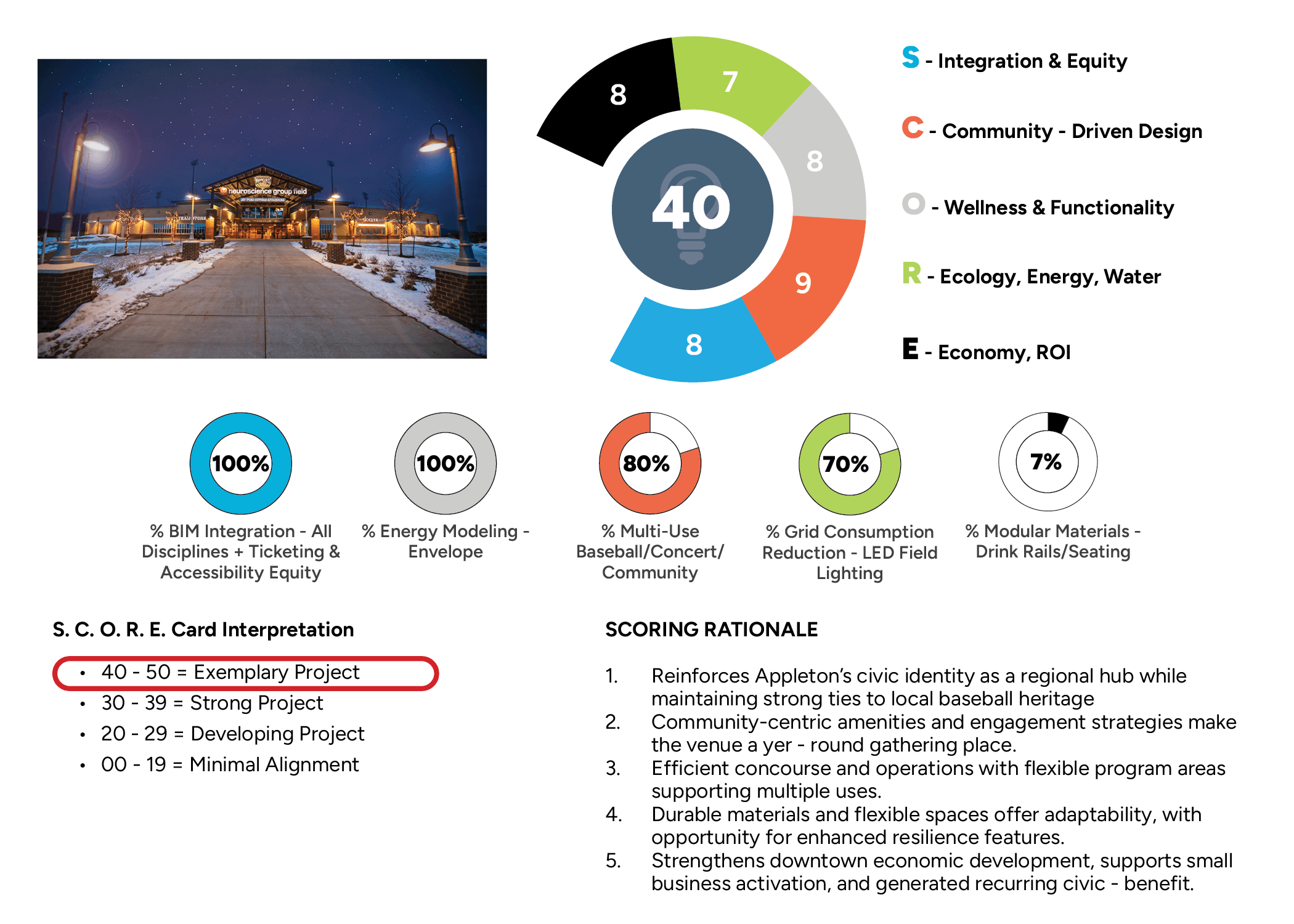

An infographic summarizing the S.C.O.R.E. performance evaluation for Neuroscience Group Field in Appleton, Wisconsin. The image features a nighttime photograph of the stadium entrance with snow on the ground and warm lighting. To the right, a circular S.C.O.R.E. chart displays a total score of 40, broken down by category: S (Integration & Equity) – 8, C (Community-Driven Design) – 9, O (Wellness & Functionality) – 8, R (Ecology, Energy, Water) – 7, and E (Economy & ROI) – 8. Below the chart are five circular metric graphics showing project performance indicators: • 100% BIM Integration for all disciplines including ticketing and accessibility equity • 100% Energy Modeling for the building envelope • 80% Multi-Use capability across baseball, concert, and community events • 70% Grid Consumption Reduction achieved through LED field lighting • 7% Modular Materials utilization for drink rails and seating. The design visually communicates quantitative performance outcomes within the S.C.O.R.E. framework, highlighting sustainability, multi-functionality, and efficiency.

Dunkin’ Park – Hartford, Connecticut (Completed 2017)

An infographic showcasing the S.C.O.R.E. performance assessment for Dunkin’ Park in Hartford, Connecticut. The image includes an aerial photograph of the stadium taken at sunset, showing bright field lighting and a busy parking area. To the right, a circular chart displays a total S.C.O.R.E. of 42, broken down into five categories: S (Integration & Equity) – 9, C (Community-Driven Design) – 9, O (Wellness & Functionality) – 8, R (Ecology, Energy, Water) – 7, and E (Economy & ROI) – 9. Below the chart, five circular metric icons present quantitative project data: 100% BIM integration across all disciplines including ticketing and accessibility equity, 100% energy modeling for the building envelope, 70% grid consumption reduction achieved through LED field lighting, 66% multi-use capacity for baseball, concerts, and community events, and 3% modular materials used for drink rails and seating. The design visually communicates the project’s balanced performance across social, environmental, and operational domains within the S.C.O.R.E. framework.

Cool Today Park – North Port, Florida (Completed 2019)

An infographic showing the S.C.O.R.E. performance evaluation for CoolToday Park in North Port, Florida. The image features a photograph of the baseball field with players on the grass and two people standing together in the foreground under a sunny sky. To the right, a circular chart displays a total S.C.O.R.E. of 41, divided into five categories: S (Integration & Equity) – 8, C (Community-Driven Design) – 8, O (Wellness & Functionality) – 9, R (Ecology, Energy, Water) – 7, and E (Economy & ROI) – 9. Below the chart, five circular indicators show specific performance metrics: 100% BIM integration across all disciplines including ticketing and accessibility equity, 100% energy modeling for the building envelope, 75% multi-use flexibility for spring training, minor league, concert, and community events, 70% grid consumption reduction through LED field lighting, and 7% modular materials use for drink rails and seating. The graphic conveys how the project achieves balanced environmental, operational, and community performance through the S.C.O.R.E. framework.

Up Next: WiSE Stadium – Wilson, North Carolina              (Scheduled Completion 2026)

An aerial architectural rendering of a modern baseball stadium complex surrounded by city streets and green space. The stadium features a brick exterior facade, a full baseball field with players on the field, and seating areas wrapping around home plate and along both baselines. A large mixed-use building with residential or commercial units overlooks the outfield. The surrounding area includes tree-lined streets, sidewalks, landscaped plazas, and parking areas, illustrating how the stadium integrates with the surrounding urban fabric.


About the Author: Jonathan O’Neil Cole and the Future of Design Economics

Jonathan O’Neil Cole, AIA, NCARB, NOMA, is the founding principal of Pendulum Studio. He developed the S.C.O.R.E. Framework to align architectural creativity with technical, operational, and economic sustainability. Cole’s approach challenges architects to move beyond form-making and embrace a future where design, data, and resilience define true excellence.

Sources & References

Primary Works by Jonathan O’Neil Cole

Technical and Sustainability References

    • The American Institute of Architects (AIA). Framework for Design Excellence. AIA.org, 2023.
    • United States Green Building Council (USGBC). LEED v4 BD+C: New Construction and Major Renovation Reference Guide. Washington, D.C.: USGBC, 2024.
    • Elevar Design Group. LEED v4 Documentation and Final Scorecard: Hagerstown Multi-Use Sports & Events Facility. 2024.
    • FP&C Consultants. Life Safety Evaluation Report and Timed Egress Analysis for the Hagerstown Multi-Use Sports & Events Facility, 2024.
    • Pedestrian Wind Comfort and Stadium Microclimate Design. RWDI.com, 2022.
    • Buro Happold. Sports Venue Design and Environmental Modeling. BuroHappold.com, 2021.
    • International Code Council (ICC). International Building Code (IBC). 2021 Edition.
    • National Fire Protection Association (NFPA). NFPA 101: Life Safety Code. 2021 Edition.

Economic and Policy Context

    • United States Department of the Treasury. New Markets Tax Credit (NMTC) Program Overview. CDFIFund.gov, 2023.
    • org. “Tax Increment Financing.” Definition and Explanation of Mechanism. Accessed 2024.
    • Community Renewal Tax Relief Act of 2000. Public Law 106–554, 114 Stat. 2763.

Industry Research and Precedent Studies

    • Stadium Development Trends and Design Innovation Report. Populous.com, 2022.
    • Sports Business Journal. “The Evolution of Sports Venue Economics.” 2023.
    • Major League Baseball (MLB). Green Sports Alliance Sustainability Report. MLB.com, 2023.
    • Minor League Baseball (MiLB). Facility Standards and Design Guidelines. 2023 Edition.

Academic and Professional Frameworks

    • The American Institute of Architects. Design for Integration: Linking Creativity and Performance. 2023.

Public Safety

    • Maryland Stadium Authority. Hagerstown Multi-Use Sports and Events Facility Project Overview. 2024.
    • City of Hagerstown. Downtown Revitalization and Safety Operations Plan. 2024.
    • Hagerstown Police Department. CityProtect Crime Mapping Portal. 2024.
    • Washington County Health Department. Public Health Report: Overdose Trends. April 2024.
    • Hagerstown, MD Crime Statistics. 2023.
    • Hagerstown Crime Overview. 2023.
    • Hagerstown Arts & Entertainment District. Cultural Trail Connectivity Map and Master Plan. 2023.
    • Baseball Reference. Hagerstown Baseball History and Team Lineage. Accessed 2024.
    • Maryland Historical Trust. Hagerstown Historic District Inventory. 2022.

Photo Credits

    • Dunkin’ Park – Robert Benson Photography
    • Meritus Park  (Aerial View) – Eric Hastings
    • Meritus Park (Field View) – Turner Construction
    • Cool Today Park – Atlanta Braves


Related Articles

WISCONSIN TIMBER RATTLERS ANNOUNCE BALLPARK IMPROVEMENTS FOR 2023

Dunkin’ Donuts Park Opening Day – Yes…We’re Still In Love With The Ballpark

Hanging With Mr. Buck O’Neil

This short story illustrates how inspiration feeds design

The Light

Our CEO Jonathan O’Neil Cole had the privilege of hanging with Mr. Buck O’Neil and Mr. Bob Kendrick at the 2005 Baseball Winter Meetings in Dallas, TX – It was a day he’ll never forget!

This is the story of how Buck’s light shined so bright that it inspired a chain reaction of events that continue to resonate 17 years later. Pendulum’s collaboration with Mr. Sean Kane on the Buck O’Neil tribute painted glove was incredibly special. The images below are the illustrator’s design notes as we progressed through the process of design.

In addition to the Buck O’Neil Tribute Glove, Pendulum commissioned Sean Kane to paint a tribute to Hank Greenberg pictured below.

The Look Ahead

While many organizations use this time of year to reflect on past accomplishments, Pendulum’s focus is straight ahead. We are committed to more dynamic collaborations with incredibly talented and passionate creatives. Stay tuned for several major announcements first quarter 2023.

Acknowledgments

Lighting the ‘FUSE’ on a Dream Like Ballpark In NC

“Architect Cole has broken the code for creating 5,000-seat ballparks for half the budget of other such facilities.” – Jock Mock USA Today Sports

USA Today Sports Weekly released an in-depth article by Joe Mock. The article chroniclesMock’s recent visit to CaroMont Health Park, home of the Gastonia Honey Hunters. The Honey Hunters are the newest Atlantic League team located in Gastonia, NC.

on May 27, 2021 CaroMont Health Park opened to a capacity crowd. To add to the fanfare, Earvin “Magic” Johnson made an in-person appearance as a show of support to the Gastonia community and team owner Brandon Bellamy.

Click this link to read the full article: USA Today Sports Weekly June 23 – 29, 2021

CaroMont Health Park/FUSE District Phase Two Development Concept

Phase one construction for the ballpark is complete, now our sights are set on the surrounding commercial development. Pendulum authored an advance look at what phase two may entail – see image above for a broad overview. Pendulum will continue to expand our efforts at “breaking the code” forward thinking design. Affordable solutions to economic development with sport facilities as the catalyst for growth is our specialty.

The Grill Nation Show Preview – Next up: Jason Grill & Pendulum’s Jonathan Cole

The Grill Nation Show featuring Jason Grill and Jonathan Cole will air on Saturday July 11, 2020 on KMBZ 980AM and on iTunes.  In this clip Cole answers the question “what is your favorite stadium (that you didn’t work on) and why?”  It is just a sneak peek of the full conversation that goes into detail about Pendulum’s history, inspirations, emotional muscle memory, and design methodology.

Be sure to tune in on Saturday…this will be a lot of fun!


For Immediate Release – Jonathan O’Neil Cole Acquires 100% Ownership of Pendulum Studio, LLC

Kansas City, Missouri, July 1, 2020

As founding principal, Jonathan O’Neil Cole has served as managing member and 51% owner of Pendulum, a Kansas City-based architecture firm, since its launch in 2007.  As of July 1, 2020 Cole has acquired the remaining 49% balance of company shares and shall continue serving in his role as practice leader and CEO.

“I am honored to be in the position to continue to lead Pendulum in the direction of growth and innovation.  While this acquisition is more of a formality, I do believe it will provide a great deal of clarity for our employees, collaborators, and past, present, and future clients.  While there are very few things I’d change about our history, we’ve certainly got an extremely bright future ahead of us,” Cole said.

About Pendulum

Founded in 2007 in Kansas City, Missouri, Pendulum has gained notoriety in the sports architecture marketplace with the design of thirteen built sports facilities and counting.  Of recent note Pendulum teamed with Florida based Fawley Bryant Architecture to complete the design of Cool Today Park, spring training home of the Atlanta Braves.  The completion of Cool Today Park in March of 2019 was quickly followed by the two firms being selected to design the  renovation of Roger Dean Chevrolet Stadium, spring training home of the Miami Marlins and St. Louis Cardinals.  In addition to sports architecture Pendulum has developed a reputation for the design of unique Kansas City, Missouri commercial buildings including The Guild, RW/2 Studios, and Crosstown Substation.

About Jonathan O’Neil Cole, AIA, NCARB, NOMA

Education

    • 1990 – 1995 California Polytechnic University Pomona, Bachelor of Architecture

Positions Held

    • 1995 HNTB Corporation – Irvine, CA – Design Staff Member
    • 2001 HOK Sport S+V+E – Associate Staff Member
    • 2006 360 Architecture – Architect/Market Leader
    • 2007 Pendulum – Principal

Awards

    • 2020 Rethinking The Future Awards – Future Stadia
    • 2019 CSI Award, Innovative Design + Function – Wyco Vintage Broadway Kansas City, Missouri
    • 2019 CSI Award, Visionary Design – Cool Today Park North Port, Florida
    • 2018 CSI Award, Community Investment – The Corner Ballpark Detroit, Michigan
    • 2018 CSI Award, Excellence in Craftsmanship – Dunkin’ Donuts Park Hartford, Connecticut
    • 2018 Hartford Magazine Best Sports Venue – Dunkin’ Donuts Park Hartford, Connecticut
    • 2018 Kansas City Business Journal Coolest Office Award – Pendulum Headquarters Kansas City, Missouri
    • 2017 Ballpark Digest Best Ballpark Award – Dunkin’ Donuts Park Hartford, CT
    • 2017 Baseballparks.com Ballpark of the Year – Dunkin’ Donuts Park Hartford, CT
    • 2017 ACEC Michigan Engineering Eminent Connector Award – Jimmy John’s Field Utica, Michigan
    • 2017 Phoenix Community Impact Award Excellence in Brownfield Redevelopment – Jimmy John’s Field Utica, Michigan
    • 2017 IIDA Mid America Design Silver Award for Renovation & Restoration – Pendulum Headquarters Kansas City, Missouri
    • 2017 NOMA Honor Award, Built Category – Dunkin’ Donuts Park  Hartford, Connecticut
    • 2016 Ballpark Digest Best Renovation – AutoZone Park Memphis, Tennessee
    • 2014 EDC Cornerstone Award – Crosstown Substation Kansas City, Missouri
    • 2013 NOMA Design Excellence Citation – RW/2 Studio & The Guild Kansas City, Missouri
    • 2013 EDC Cornerstone Award for Residential Building – East Village Apartments Kansas City, Missouri 

Pendulum Celebrates 13 Year Anniversary!

May 18, 2020 was the 13th anniversary of the launch of Pendulum.  Under normal circumstances we’d be gearing up for an amazing party with friends and close collaborators but these aren’t normal times with COVID-19 forcing the globe to proceed with caution.

Even though we can’t gather together in one place, our CEO Jonathan O’Neil Cole shared a few words about what this year means to him.

Many thanks to our staff, clients, close collaborators for fueling our ability to keep swinging.

Shout outs:

Behr Productions – music score


Public Assembly Spaces Post COVID-19, Brief Thoughts on a Path Forward


Pendulum’s 2019 Design Journal Release

Every year for the last nine years Pendulum has completed a new or substantially renovated ballpark in addition to other civic and/or boutique projects.  In the last three years we’ve made a conscious effort to shift our focus from a traditional architectural delivery methodology to a process that encourages a curating of the built environment.

Most of our clients as well as the users of our buildings are heavily influenced by art, fashion, food, music, environment, and automobiles just to name a few.   The combination of these elements in interior and exterior spaces fosters enhanced user experiences.  There is a certain vibe that people are looking for when they attend events in or around our facilities.  Most people don’t spend much time thinking about why something is cool or why it feels right, but they immediately know when something is off, when the vibe is not authentic.

Our job as curators of the built environment is to design experiences that feel effortlessly appropriate and ahead of the curve.  This design journal exposes you to some of our triumphs as well as our process.  It is evidence that we not only talk the talk…we live it.

Dunkin’ Donuts Park Opening Day – Yes…We’re Still In Love With The Ballpark

The most common question I get from people when they find out I design ballparks is: “which ballpark is your favorite?”.  I always respond the same way because it’s true, “ballparks are like your children, you love them all”. The unspoken truth is that from time to time there’s one that rises above the rest, but still, the right answer is “you love them all”.

A habit I’ve developed over the last 24 years in the business is to go back to ballparks I’ve designed to check on how they’ve held up.  Reconnecting with my friends in the front office (the operators) is something I’ve found a lot of joy in.  When you think about it, who better to give feedback on the design than the people who live in the ballpark everyday?  In an even greater sense, it’s rare to share a more intimate experience with a stranger than being in each other’s company on a weekly basis for months  dealing with the stresses of the design process, budgeting, the intensity of the construction phase, and the feeling of joy after the work is complete; it’s a process that most people will never understand until they experience it, and the truth of the matter is very few people are afforded that opportunity.

I’ve been back to Dunkin’ Donuts Park at least ten times since its completion. Every time I’ve been I’ve enjoyed a surprising calm, free of the nervous anticipation I typically have when I visit some of my other past projects.  This warrants further explanation… The reality is, once the front office takes occupancy of the ballpark, It’s no longer under my control.  I don’t have the authority to influence what happens to the design after spending months nurturing it and well over a year monitoring developments during construction. To add insult to injury, after a season or two it’s been long enough that when I check in at the front desk no one even remembers who I am.  It’s no longer my ballpark, it’s theirs…sometimes that hurts.  Dunkin’ Donuts Park is different.  Every time I’m at or around the ballpark I feel at home, almost like I never left.  That’s a HUGE testament to the ownership of Josh Solomon and the leadership in the front office with Tim Restall and Mike Abramson.

I was invited to attend the final home game of the 2018 season at Dunkin’ Donuts Park.  As usual I walked from the heart of downtown, across Interstate 84, and straight up Main Street to the intersection of Main & Trumbull. The first thing that always catches my eye is the custom billboards above the “Retro Brands Team Store”. This design feature is special to me because we had to fight for it.  Believe it or not it wasn’t me fighting the owner; Josh Solomon was always on board 100%. Josh and I had to team up and convince the staff that we weren’t crazy. I won’t say they hated the idea… but they certainly didn’t love it.  In all honesty I think the hesitation was more related to nervousness about “the unknown”; the reality is we were taking a leap with this one. Nobody else in MiLB had this, so the advice from MANY folks inside and outside our circle was to save the money and pass on the idea. I have to give Josh credit… I will never forget the conference call as we planned the photo shoot for the billboards. Someone said, “let’s pass on this idea”… and Josh said, “It’s time to step up and take the shot guys… we are doing this, so get on board.”  The next thing you know the photo shoot is set with Internationally known photographers “The Wade Brothers” and the Yard Goats are shipping merchandise to Kansas City for the shoot.

Downtown Hartford has been bisected by I-84 for quite some time. It disconnects the northern portion of downtown from the southern two-thirds of downtown where the bulk of traditional urban retail, commercial businesses and entertainment exist. We encouraged the City of Hartford to site Dunkin’ Donuts Park in it’s current location to link the north and south with a visual terminating point. The ballpark anchors new development and increases pedestrian foot traffic, thus breathing life into the virtually abandoned edge of downtown. Instead of designing billboards that celebrate star athletes, as is typically done, we dressed everyday people of all shapes, sizes, and racial backgrounds in Yard Goats merchandise with the simple messaging “No Goats No Glory”. Our crazy idea was to celebrate the urban nature of our site while sending the important message that you don’t have to be an athlete to be great. You can be anyone from the neighborhood, just work hard and aspire to be great.  Our plan worked out brilliantly because Main Street, as you walk across Interstate 84 visually
terminates right into the billboards; you just can miss the message. We placed additional billboards along Pleasant Street (north boundary of the site), which just happens to be across the street from an elementary school.  The simple message there reads “Be Amazing”.

After passing the Main Street billboard I walked toward the VIP entry, checked in at the front desk, then went upstairs to the premium level. As usual I made a bee-line to the outdoor club seats behind home plate to take a seat and let it all soak in. This is my favorite pregame spot to capture a panoramic view of the seating inventory throughout the park. This is the time when the team is warming up on the field, the guys in the video production room are running through graphic programming for the game and staff is finishing last-minute pregame tasks… the calm before the storm when the gates open to the public and it’s time to play ball.

Once the gates open at 6pm I typically head indoors to the YG Club to see how the early crowd (pre-game parties and groups) use the space.  The unobstructed view of the field from inside the club behind home plate encourages patrons to lounge between the bar and the open seating without feeling like they’re missing anything. The club is certainly one of my favorite features of the ballpark because it has the right energy. We purposefully designed the space for light levels, interior finishes feel dark enough to be just above a night club but not so bright that you feel like you’re in a cafeteria… it’s right in the pocket. The addition of the carving station that serves prime rib sandwiches was a nice move by the Yard Goats this season, it really contributes to the deliberate upscale feel of the club. It’s clear by the way people use the space that they feel comfortable and at home.

At around 7:15pm, the starting lineup had been announced and the national anthem had been performed. Although this was the 47th sellout of the season the seating bowl seemed to only be half full. It’s not because people weren’t there but because patrons were navigating the concourse and enjoying the many strategically placed activation spaces throughout.  Each of the concession stands were branded to pay tribute to Hartford, CT history. “Dark Blues Diner” gives a nod to the Negro League team that played in Hartford in 1874 to 1876: The Hartford Dark Blues.  “Huck’s Hot Corner” is a play on words honoring The Adventures of Huckleberry Finn, written by Samuel Clemons (Mark Twain) whose childhood home remains a historic landmark in Hartford.  “The Whistle Stop” is a locomotive themed food cart that references the “New York, New Haven and Hartford Railroad Company” that operated in the New England region of the United States from 1872 to 1968.  There’s “Reggae In Right” which is a food cart celebrating Hartford’s Caribbean culture.  The cart, on the upper deck in right field, offers items from Scotts’ Jamaican Bakery, a family owned local business with deep Jamaican roots. Another local favorite is “Bear’s Smokehouse Barbecue” which occupies a purpose-built casual dining area in the left field corner. I can still remember the spirited design discussions with the team about the desire to create destinations on the concourse that contribute to the “emotional muscle memory” of the patrons. The plumes of BBQ scented smoke in the air, the sweet smell of Dunkin’ Donuts glaze… it’s all part of the experience that generates a time stamp in our minds, it’s these sensory memories that keep us coming back to the ballpark. The traditional peanuts, popcorn and Cracker Jack offerings will never be replaced but the emergence of innovative and regional options is a definite move toward the future.

At 7:30PM I headed toward the outfield group areas. Along the way I stopped off at the Beer bat stand. This is an added feature this season and another example of the Yard Goats’ willingness to enhance the fan experience by collaborating with local business.  A local cup company that uses architects to design interesting vessels for drinks in Las Vegas pitched the Goats on cups shaped like everything from goats to trash cans as a novelty item. Yard Goats President and 2017 Eastern League Executive of the Year Tim Restall said, “what about a full size bat?”.  The rest is history… and people are absolutely loving it! $9 buys an empty bat, $19 buys a bat full of beer, and you can refill the bat for $10. The promotion was such a hit that people who purchased a bat on a Monday returned later in the week on Thursday and kept the party going!

As I walked around the left field foul pole, the group area right below the scoreboard is the first section of seating I encountered. That we chose to design the bowl without a grass seating berm feature is one of those decisions that many people questioned, but to this day I think was the right move.  Dunkin’ Donuts Park is urban, so I’ve always thought about the seating bowl as a bunch of small neighborhoods. Home plate and behind the dugouts is where the baseball purists sit for an authentic experience. The third baseline just below “Bear’s BBQ Pit” is a super cool section of seating called “Dunkin’ Dugout” that the Yard Goats donate to community groups every game. The left field foul pole seats were always in our plan to be the rowdy section of the park. Technically speaking, the seats are only five feet above the playing field surface with only a wire mesh rail separating patrons from players. This is next to the visitor bullpen that is just below the “Connecticare Picnic Pavilion” which terminates right into the center field batter’s eye. The entire outfield from the left field foul pole to the “Travelers Kids Fun Zone” was designed to feel totally different from behind home plate; it’s reminiscent of a smaller version of the outfield bleachers at Wrigley Field.  When walking through “Travelers Kids Fun Zone” and heading towards right-center field the ballpark transforms to a double-deck area that again wraps itself around the home team bullpen (which is also visible from outside the secure line as you walk along Trumbull Street). This area was inspired by Fenway Park that very similarly exists within a very tight footprint.  We emulated Fenway’s steel shapes and narrow concourses with the entire area of seating behind protective netting.  Home runs that are hit in shallow right field must be hit over the 250’ long video display that serves as the edge of the approximately 650 fixed seats and open concourse, roughly 24’ above the playing field surface.  At the end of the right field concourse directly behind the foul pole our stroll ended at the “Hanging Hills Short Porch”.  We decided to poke fun at ourselves a bit for having such a short porch, so we ran the foul line all the way though the bar and up the wall.

Before I headed upstairs to the upper right field seating I stopped off at “Sheriff Tim’s Patty Wagon” a freshly made burger stand that was added this season. This is located right below the elevated premium seating area I affectionately refer to as “The Knuckle”, which is technically called “The Hartford Terrace”. I still prefer “The Knuckle” but I get the sponsorship angle for sure.  This is one of my favorite locations on the main concourse, entering the main gates of the park, it’s the first view of the field that hits you. This spot is flanked by the main stair tower that supports the massive “Dunkin’ Donuts Park” naming rights sign on the left, the “Retro Brand Team Store” on the right as well as the game day starting lineup. This is the best place to people watch and listen to conversations and reactions as people walk in and around the concourse. On that particular night I heard a gentleman, an obvious out-of-towner, say, “Wow! Hartford did it right! They didn’t overbuild, it’s not too big… it’s perfect!”. I think his read was right on point.

It was time to navigate the final leg of my lap around the ballpark before heading to the Owner’s suite for a check in with the family and then back downstairs to the dugout suites to watch the annual end of season concert (more on that later). I always find it interesting to analyze the way patrons use the ballpark once construction is complete and I’ve moved on.  Although we originally envisioned the right field upper deck seating as a means to an end to get to the right capacity, the area has actually become the hang out spot for young professionals. As I stood at the Budweiser standing tables that Tim Restall brilliantly added this season, I noticed a swarm of people arriving from the center field stair tower. They made a quick pit stop at the “Budweiser Sky Bar”, positioned directly above the batter’s eye screen, grabbed a drink at the bar and then circulated the upper concourse. This area is a heavily trafficked millennial haven that was my second favorite place to people watch and listen to casual conversation. By the time the game had progressed to the top of the seventh inning the upper concourse and seating was jam-packed, so much so that it became hard to see the field below due to the constant traffic and hordes of milling patrons. It was time to work my way to the Owner’s suite. It was perfect timing because the artist that was to perform the post-game concert had made their way to the suite and we stuck around for a bit talking about the music we grew up on.

At the end of the 2017 season the Yard Goats booked hip hop legend Curtis Blow,2018 year they had a double feature of Black Sheep and DJ Kool. It’s endearing to me that the team is 100% in tune with the surrounding community. We’ve all worked with people in the business with “attitudes” and that’s absolutely not what we’re talking about with team owner Josh Solomon and his family. Josh is tough, a business man, but fair, authentic and genuine. He surrounds himself with like-minded people and I appreciate that. There were many times during the stadium design that we had tough conversations (real talk), direct conversations, and sometimes weird stressful situations based on the goings on of the project that are well documented in the local Hartford news journals. Even so, we always had respect amongst the group and a genuine desire to extract the absolute best out of everyone involved in the project.

The post-game concert was a blast! The crowd was engaged and the artist was exactly like I remembered: seasoned veterans of the game with the ability to move the crowd with classic hip hop tunes… an incredible way to end the season.  The Yard Goats didn’t make the playoffs but honestly, I don’t think it really matters.  The citizens of Hartford came out and supported the home team, selling out seven more games than the season before and I’d be willing to bet money that they’ll sell out at least ten more games in 2019… that’s how much I believe in the people behind the brand.  I can honestly say without hesitation that I am still in love with every inch of Dunkin’ Donuts Park. To be clear: it’s not just because I designed it, this feeling is much bigger than that.  It’s the staff, the community, the passion of the ownership, it’s their willingness to put themselves out there every game and present themselves as just that much better than their counterparts.  I will forever be a fan.

So to the good folks within the Yard Goat organization, have a great season…keep breaking records.  It’s no mistake that “The Dunk” was voted best ballpark 2017 and 2018.  The 2019 season is upon us – let’s get it!

Credits:

Lee Frommelt: Copy Editor

The Hartford Yard Goats: Community Advocates

Photography: Robert Benson Photography


Design Is Everywhere Volume 01 – Launch From The Hive


We’re launching a new series that explores the many aspects of daily life that influence our designs. As we release each volume in the series you’ll notice that we often reference “the process”, that is deliberate. We find it interesting that as designers our natural tendency is to hide our process, we don’t want our audience to know the steps it took to arrive at a final thought…we project the idea that our first thought was perfect, as if we are perfect, yet reality is quite the opposite.  Our best designs are the product of collaboration.  It is the result of our willingness to be influenced by the things we see, hear, and smell, the people we surround ourselves with (our circle) that are chipping away at the same block of ice that we are but from a slightly different vantage point.  It’s the applied pressure from our circle that challenge us to do better and be better, even when we get deal fatigue*.

Tinker Hatfield & Jordan 3

Gehry Residence 1978

Museo Guggenheim Bilbao

What is most interesting about the concept of “deal fatigue” is that it is a phenomenon only experienced by the designer.  The end-user/consumer is never exposed to the steps associated with getting from point A (the beginning), to point B (the end), so this concept is foreign to them.
The consumer in general sees something they like, and they go buy it.  The designer in contrast has to create, edit, market, and sell the idea.  Think about it – how many different versions of the Air Jordan 3 do you think Tinker Hatfield studied before he pitched Michael Jordan who was at the time frustrated with Nike and considering leaving the brand?  The end result was Tinker’s design and it saved the day…the rest is history.  How many attempts in material study did it take for famed architect Frank Gehry to arrive at Museo Guggenheim Bilbao?  When you think about it, his trajectory toward use of a material that defies gravity started with chain link fence.  A very simple, affordable, and readily available sheet good that is pliable in multiple directions.  “The process” of study, trial and error eventually led him to the use of titanium which is also a pliable sheet good…but not as readily obtainable, much more expensive, but perfect for the application.  The end result is architecture that inspires us to aspire to challenge conventional methodology.

As an owner of an architectural firm, I’ve noticed amongst young talent the hesitancy to expose the process.  There’s this gravitational pull toward putting on our headphones and hiding in our cocoons and spending hours upon hours cranking way on what we think is the perfect solution.  It almost seems as if what’s really being taught at universities is the idea of self-reliance as a path to success which cheats the process. I’ve seen MANY portfolios in interviews where I look at the finished product and think to myself “wow, this is impressive”, only to realize that the individual was working in their cocoon all by themselves for the better part of a year to produce something that in real-time we’d have to produce in a couple of weeks.  It’s the most difficult adjustment for young talent to make…the transition from theory to real-time which is about twenty times faster.

I’ve concluded that the cocoon that we all gravitate toward climbing in as a default is really our safe place that protects us from vulnerability.   I think the people most successful at breaking boundaries, innovating, and generating new ideas are the people who are OK with exposing their vulnerability.  Those that are OK with looking a little weird or sounding a little crazy.  They are not afraid to be excited or show genuine emotion for the people around them that are exploding with talent.  They let their fears push them ahead rather than stand in front of them and impede forward progress.  The “Design Is Everywhere” series is our gesture of stepping outside of our cocoon and exposing you to the things we encounter on a daily basis that inspire us, the people in our circle that push us, the highs of challenging the market and our competitors, the inevitable lows of missing the mark, and yes – the occasional occurrence of crazy.

We are not afraid…let’s get it!

Stay tuned for Volume 02 of “Design Is Everywhere” – Sportswear Passion.

Footnotes:

*  Deal fatigue is a term used to describe the point of mental and physical exhaustion when working on a project because for various reasons often out of the designer’s control, the project seems as if it will not come to completion.  

Credits:

Lee Frommelt – Copy Editor